Discussion
According to MRK 15:23, Jesus was offered “wine mingled with myrrh” just before his crucifixion, possibly by his followers, as a sedative. Matthew, seeking to draw a parallel to PSA 69:22 a (“They gave me poison [cholē in the Septuagint] for food”) writes “they offered him wine to drink, mingled with gall” (MAT 27:34), using the generic Greek word cholē for gall/poison, thus emphasizing the humiliation that the Savior endured.
Description
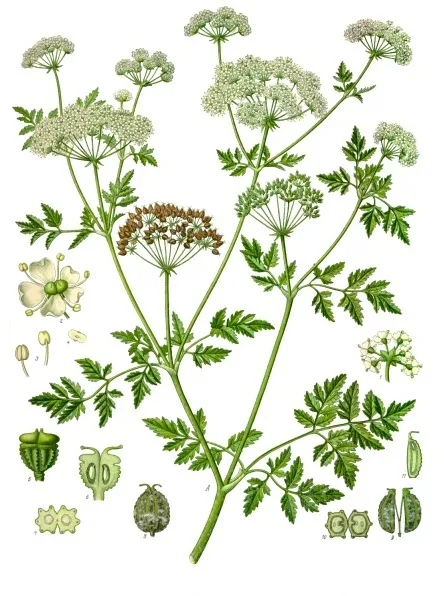
Poison hemlock can reach 1.5–2.5 meters (5–8 feet) in height. It has a smooth green stem with purple or red streaks toward the bottom. Its leaves are lacy like a carrot’s and up to half a meter (2 feet) long, and it has tiny white flowers grouped in the form of little umbrellas. People mistake it for parsley or wild carrots. Its root is stout and resembles that of European parsnip. Its leaves and root give off a bitter smell.
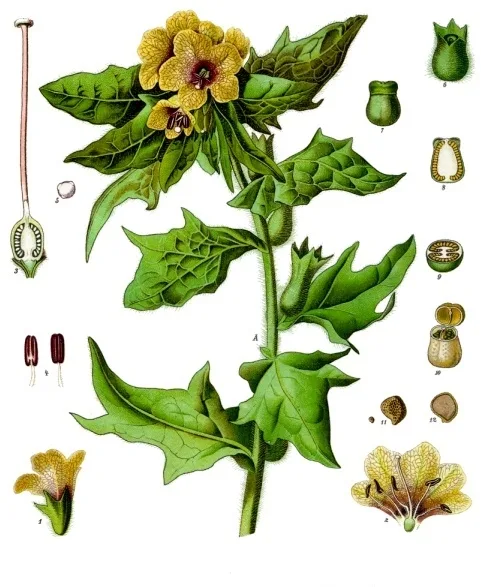
The biennial henbane has different forms but in general grows a meter (3 feet) or more high, including the flower. It has an erect, branching stem with white flowers in umbrella-shaped heads. The gray-green egg-shaped leaves have sharp tips, may reach 30 centimeters (1 foot) in length, and are covered with sticky hairs.
Poison hemlock was used as a sedative in ancient times by both Greek and Arab doctors, but it was risky since an overdose was fatal or resulted in loss of speech or paralysis. Henbane (meaning “hen-killer”) was used in medicine by the Greeks to induce sleep and to counteract pain. Europeans used it in the Middle Ages and there are Anglo-Saxon works on medicine dating from the eleventh century that mention it under the name “henbell.” Poison derived from hemlock is called “conine.”
Translation
All the Old Testament references to ro’sh /rosh are in rhetorical contexts, giving translators freedom to find local words that are powerful. Further, most languages have a word for poison, since it is frequently used in hunting and fishing, or for killing rats. Half of the references are paired with the Hebrew word la‘anah (see Wormwood), so the translator will need to look for a pair of words that fit together. If there is no word for poison, the name of poisonous plants can perhaps be substituted for the pair. Hemlock itself grows throughout central and southern Europe and in Asia and North Africa, and it has been introduced into North and South America. Henbane grows wild throughout central and southern Europe, in western Asia, India and across to Siberia. It now also grows in North and South America, especially in Brazil. A related species of Hyoscyamus is found in the Canary Islands and across North Africa to Asia.