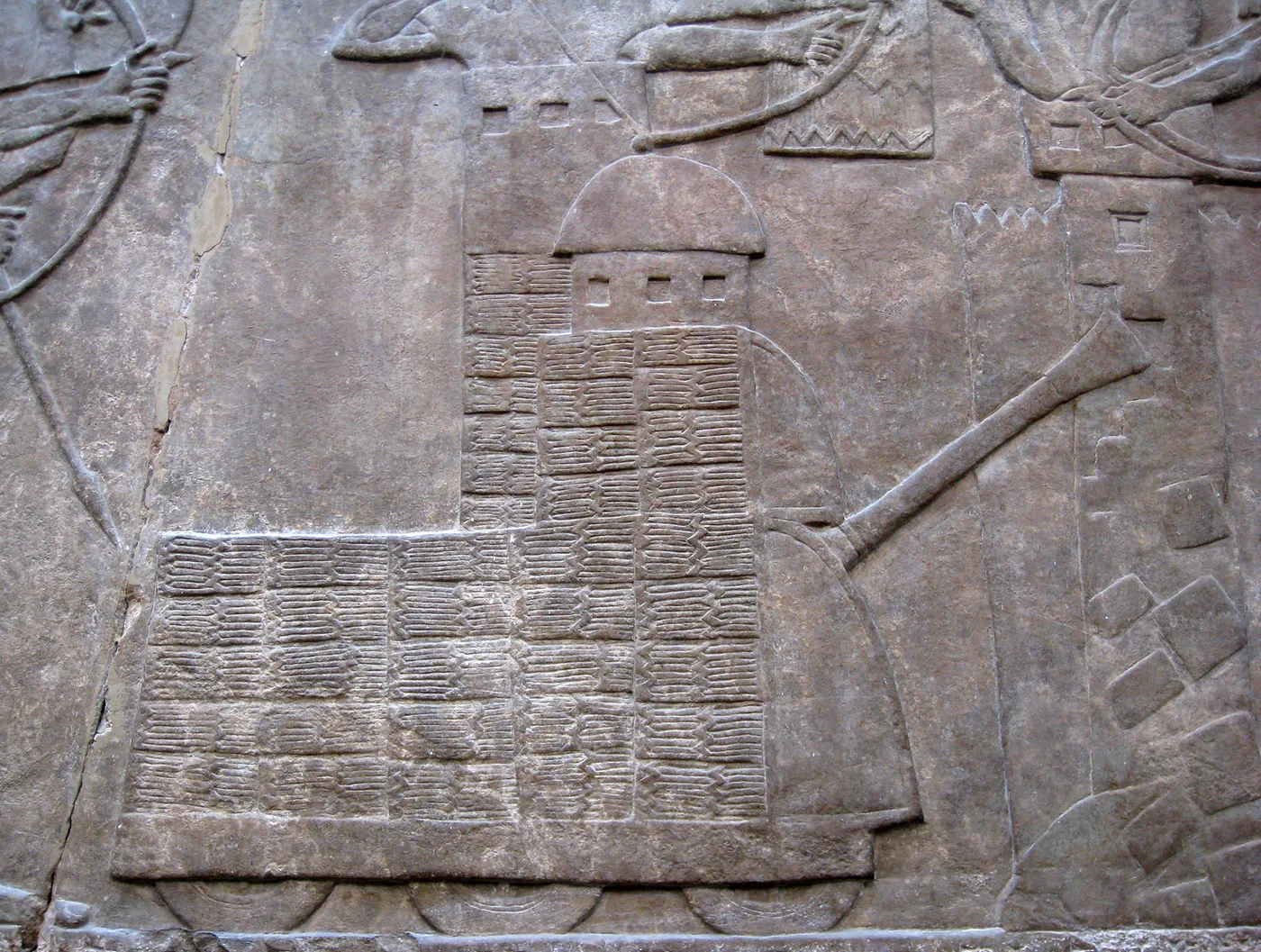
Description and usage
The battering ram was a log or other long, heavy piece of wood covered on one end with metal. It was rammed by soldiers against the wall or gate of a city under siege. It sometimes had a point since the purpose of the ramming was to wedge a hole in the wall. Others were blunt on the end. Repeated banging on the wall weakened it and caused it to fall or opened a hole in it. After the ram had penetrated the wall, it would be levered back and forth until that section of the wall fell. It could be held and swung by soldiers, or sometimes it was suspended by ropes from a moveable wooden tower.
Translation
Where there is no word for “battering ram,” translators may use a descriptive phrase. In EZK 26:9NCV has “He will bring logs to pound through your city walls,” and CEV says “He will command some of his troops to use large wooden poles to beat down your walls.” However, ITCL “They will pound your walls with their heavy weapons” may be misleading to the modern reader.
EZK 26:9 has the Hebrew word cherev. While this word normally means “sword,” the context here makes this interpretation unlikely. In EXO 20:25 the same word means something like “chisel” (GNT). Here in EZK 26:9 it seems to refer to a heavy iron tool that could be used to break apart a stone wall. De Vaux suggests a kind of battering ram with a pointed head or a sapper’s pick. Translations have various renderings, such as “axes” (RSV, REB), “iron rods” (CEV), “iron bars” (GNT, NCV), and simply “weapons” (NIV).