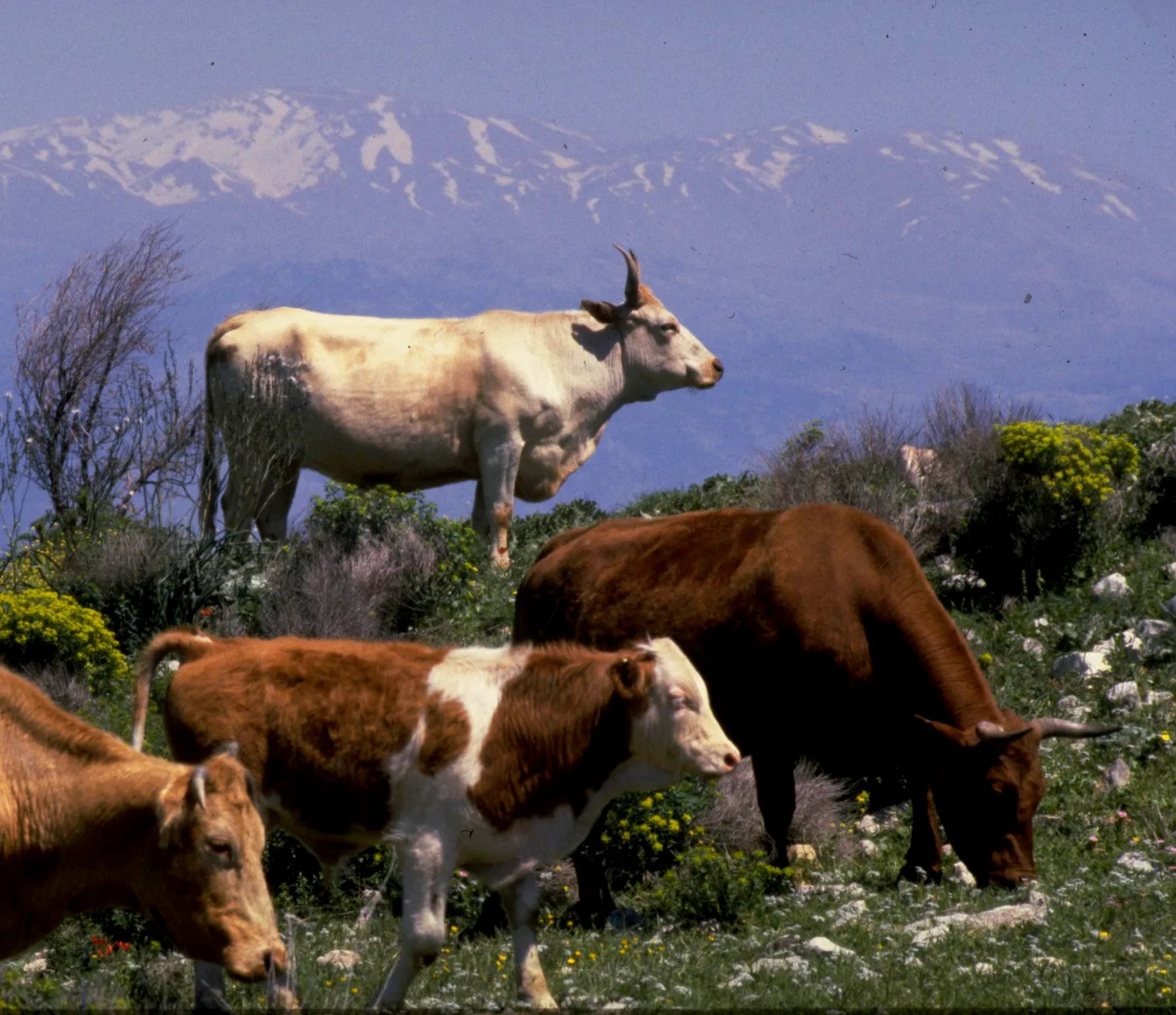
Discussion
Cattle herding and breeding among the Hebrews are first mentioned in GEN 12:16, when Abram is given cattle by the king of Egypt and brings them back to Canaan. From this time on cattle formed an important element in Hebrew life and culture, although ownership of cattle was limited to relatively wealthy people. The area of Gilead in particular, became known for the number and the quality of cattle there (NUM 32:1; NUM 32:4; 1CH 5:9).
English terminology
For the sake of readers who are not mother tongue speakers of English it seems best to clarify the rather bewildering variety of collective terms for cattle. Even mother tongue speakers sometimes have difficulties with these.
Cattle: This word in modern English is a plural form but there is no singular or countable form of the word. So when referring to a specific number of animals of this kind one has either to use expressions such as “five head of cattle” or to specify the gender of the animals in expressions such as “four cows and one bull.” In an earlier form of English the word meant “possessions” then it came to mean “livestock” and finally in modern English it is a more specific word referring collectively to any domestic cow-like animals whether they be cows, bulls, oxen, calves, bullocks, steers, or heifers.
Cows and Bulls: Although cows are strictly speaking adult female cattle the word in modern English is sometimes used to mean “cattle” without reference to gender especially when using numbers. Thus “400 cows” can mean “400 head of cattle.” TEV sometimes uses the word in this sense. The word for adult male cattle, “bulls", is never used with this more general meaning.
Oxen: In modern English this word refers to bulls that have been castrated in order to make them more docile so that they can be used as work animals. The effects of castration were discovered very soon after cattle were first domesticated and although the Jews were forbidden to castrate animals they seem to have obtained such animals from gentile neighbors or ignored the prohibition.
A more archaic usage of the English “oxen” has the general meaning of “cattle". This archaic usage is preserved in words such as “oxgoat", “oxtail", or “wild oxen", where the gender of the animals is not a component of the meaning. It is this archaic general sense in which most English versions use the word especially when quantifying. Thus in these versions “400 oxen” means “400 head of cattle” not “400 castrated bulls.” This is the reason why we find reference to oxen being sacrificed even though there is a specific prohibition against sacrificing animals that have been castrated.
Steers: These are castrated bulls that are raised for slaughtering not for work.
Bullocks: This word generally means young bulls but in some dialects of English such as Australian it can also mean the same as “oxen” or “steers", that is, castrated bulls.
Heifers: This is the word used for young cows that have not yet given birth to their first calf.
Calves: These are young cattle of either sex.
Dairy products
Cows, sheep and goats were all milked by the Israelites. However because of the climate in which they lived and the way in which milk was stored in goatskin bags the milk did not stay fresh very long. They probably drank sour milk as do most other nomadic herding societies. When sour milk is shaken lumps called “curds” separate from the rest of the milk which then becomes a thin and watery liquid called “whey". The curds can be eaten as they are and this is what is often translated as “butter” in English versions. It is not, however, what is normally called butter in the modern world. The curds can also be packed together salted and dried in flat cakes. This is what is referred to as “cheese” in most English versions. It did not keep as well as modern cheese which has a rind or skin to keep it fresh.
Description
By the time Abram moved into Canaan, several breeds of cattle had already been developed in Mesopotamia and Egypt. From bas-reliefs and, in the latter country, from paintings in tombs dating to about 3000 B.C., we know that both long-horn and short-horn varieties and varieties with and without humps were known. There were already several different colors (brown, black, white) and many combinations of these, even at that early date.
Special significance or symbolism
Cattle were ritually clean animals suitable for sacrifice and a measure of wealth. In all of the lands surrounding Israel cattle especially bulls were associated at various times with gods and were worshiped. This was true of Egypt Mesopotamia and the Canaanite tribes. It was true too of other cultures from the Minoans in the west to the Hindus in the east. Thus as well as being a source of food and wealth for the Israelites and their sacrificial animals they were also a source of temptation.
Translation
’Abir literally means mighty one and is used of people, angels, God himself, and animals. When used of animals it may refer to war-horses or to bulls. The context usually, but not always, gives the clue as to which sense is meant. The contexts in which bulls are meant unambiguously are PSA 50:13; PSA 68:31; and probably JER 50:11, although in the latter verse RSV, TEV, NIV, and NAB translate the word as “stallions". The parallelism is better retained by translating “grazing heifer in heat” and “bellowing bull” rather than “neighing stallion” in the second line.
ISA 34:7 is an interesting case. The NEB and REB rendering “bison” can be discounted. For one thing to translate like this turns a prophecy of doom into a prophecy about a hunting expedition, which is highly unlikely; but perhaps even more serious, there is no evidence at all that the European bison, also known as the Wisent Bison bonasus, was ever found anywhere near as far south as Edom.
The poetry in this verse plays on the fact that ’abir can refer to people as well as to bulls. The poem speaks of a sacrifice being prepared by Yahweh, and then, by using an ambiguous expression for the sacrificial animals, the inference is that people, not animals, are to be killed. This is reflected well in the JB and TEV translations. The poetic verse means something like:
Like wild oxen, they themselves will fall dead,
Like sacrificial bulls (parim), their mighty men.
’aluf, ’elef: These words are probably related to the root ’a-l-f-, to teach or train. Thus ’aluf/’elef indicates tame or domesticated animals. A general word for “cattle” is recommended.
Behemah usually means “animal", “domestic animal", or “livestock". In the passages listed above, it should be translated “cattle". See also Animals, general.
Baqar is the most general word for “cattle". In its widest usage it basically means “herds” and may include sheep and goats, but always includes cattle. Often it means only cattle and is used in contrast to sheep and goats. In some contexts, where baqar are referred to as having given birth, it is clear that only cows are meant.
In translating baqar translators should first determine whether the context refers to livestock in general, or to cattle specifically, and translate accordingly. Generally when an English translation has “herds” without specifying which animals are meant, the meaning of baqar is “livestock” or “domestic animals” in general. If the reference is to cattle, use a general word. In languages where there are many words for cattle, depending on gender, age, color, breed, and other things, the most all-inclusive word for cattle should be used, except when a specific context indicates otherwise, such as LEV 22:19, where bulls are obviously meant.
Meri’ refers to a stall-fed animal, usually a calf, that is reserved for sacrifice. It is best translated “stall-fed calf", “fattened calf", or “choice calf.” The NEB and REB translation “buffalo", comes from a comparison with similar words in other Semitic languages which might mean “buffalo,” but this is not widely accepted by commentators since similar words in related languages often have different meanings. For instance the English “deer” and the German “Tier” are related, but have different meanings (the German word means “animal"). In ISA 11:6 the Masoretic Text includes “and a fatted calf” but the Septuagint and the Vulgate follow a different text, and thus most modern versions do not include this phrase.
‘egel and ‘eglah indicate male and female calves (heifers) respectively. These words are also used for the images of calves worshiped by the Canaanites. NEB, NIV, and REB make this clear in the book of Hosea by translating the words as “calf-gods” and “calf-idols". Most such contexts are self-evident, but HOS 10:5 is one reference to calf-idols which most versions do not adequately identify. See, however, the New Century Version (NCV) with the “calf-shaped idol". CEV renders “idols” and adds a footnote: “The Hebrew text has ‘calves,’ referring to the idols made in the shape of calves.
Par refers specifically to young bulls reserved for sacrifice. Some commentators deduce that these are firstborn bulls; others believe that the bulls were especially fattened. This latter position is reflected in the JB translation of JDG 6:25. It is likely that both positions are correct. The age of the sacrificial bull varied from one year to three years and older, so the translation “calf” is a little misleading. Par is best translated by a phrase meaning “sacrificial bull” the first time it appears in a paragraph, and then simply bull thereafter in the paragraph.
parah is the feminine form of par and refers specifically to young cows specially fattened and reserved for sacrifice. The translation heifer is unwarranted, since in many contexts parah is used for a cow that has a calf. parah, then, is best translated simply as cow, but in AMO 4:1 fat cows is warranted. In HOS 4:16 parah is used in a simile for stubbornness. This is possibly a reference to the fact that a cow that has been stall-fed for all of its life would be reluctant to move very far from its stall. It would thus probably be difficult to move when the time came to make the journey to Jerusalem for its sacrifice. TEV uses “mule” in this verse, since this is the animal that is famed for stubbornness in English culture. If cows are not considered to be stubborn animals in the translator’s culture, a similar substitution can be made, if the substituted animal is one likely to have been known by the people of Bible times. It is not advisable to use a word like water buffalo since this brings with it the inference that Israel was an area of heavy rainfall.
shor is a general word for individual cattle. They may be male, female, or both (as NIV sometimes indicates in a footnote when translating the word as “ox"), and only the context can indicate which gender is meant. shor presents a problem to English translators because English has no countable equivalent. We have to use forms that specify the gender. The most common translation of this word in English is “ox", but this is in the archaic sense of “head of cattle” and does not indicate the gender of the animal, nor whether or not it has been castrated. Some modern versions use “cow” in this same genderless sense. In other languages where there is a word for individual cows, oxen, or bulls without reference to gender, this word should be used for shor. If, as in English, gender has to be specified, the context can usually guide in the choice. In cases where the gender is not determined by the context, a general plural word for cattle can be used.
Tor is the general Aramaic word for cattle. In English the problem of quantifying results in “young bulls” being used in the Ezra passages, and “ox” in the Daniel passages. In Ezra the meaning is cattle for sacrifices, while in Daniel the reference is to cattle generally.
Bous is the usual Greek word for cattle, male or female. In translation a general word that may refer to a bull or a cow is the best equivalent. In John the animals driven from the Temple definitely were not “oxen” in the technical meaning of castrated bulls.
MAT 22:4: The word sitistos indicates stall-fed cattle that are being fattened for slaughter.
Tauros is the usual word for “bull". English versions vary between “ox” and “bull", but there really is no difference in meaning between the various contexts in the New Testament. It is recommended that translators use a word meaning “bull” throughout. Bulls were used for feasting and sacrifice (MAT 22:4; HEB 9:13; HEB 10:4). The Greeks associated bulls (not oxen) with the gods (ACT 14:13).
Moschos is the word for a male calf or bull-calf. In ACT 7:41 a verb derived from moschos, meaning “make a bull-calf", is used.
HEB 9:13: A word or phrase for a female calf (heifer) is the best equivalent. For “wild ox” see Wild ox.