Discussion
The Hebrew word suf probably designates more than one species of the cattail, also called “reed-mace” and “bulrush.” There are two in Israel: Typha domingensis and Typha latifolia (Typha australis according to Zohary). Both species like to stand in the slow-moving water on the edge of rivers and streams. The reference to suf (“weeds”) in JON 2:6 (5) supports Zohary’s conjecture that suf may be a collective name for many water plants. Suf is paired with qaneh (“reeds”) in ISA 19:6, so it is almost certainly the cattail since both are found in marshes and slow streams.
Some writers have suggested that the “reed” placed in the hand of Jesus at his mock trial was a cattail stalk (MAT 27:29). Others have countered that a cattail flower stalk would not have been ripe that early in the year. But it could also have been a stalk from the previous season. The debate continues.
Description
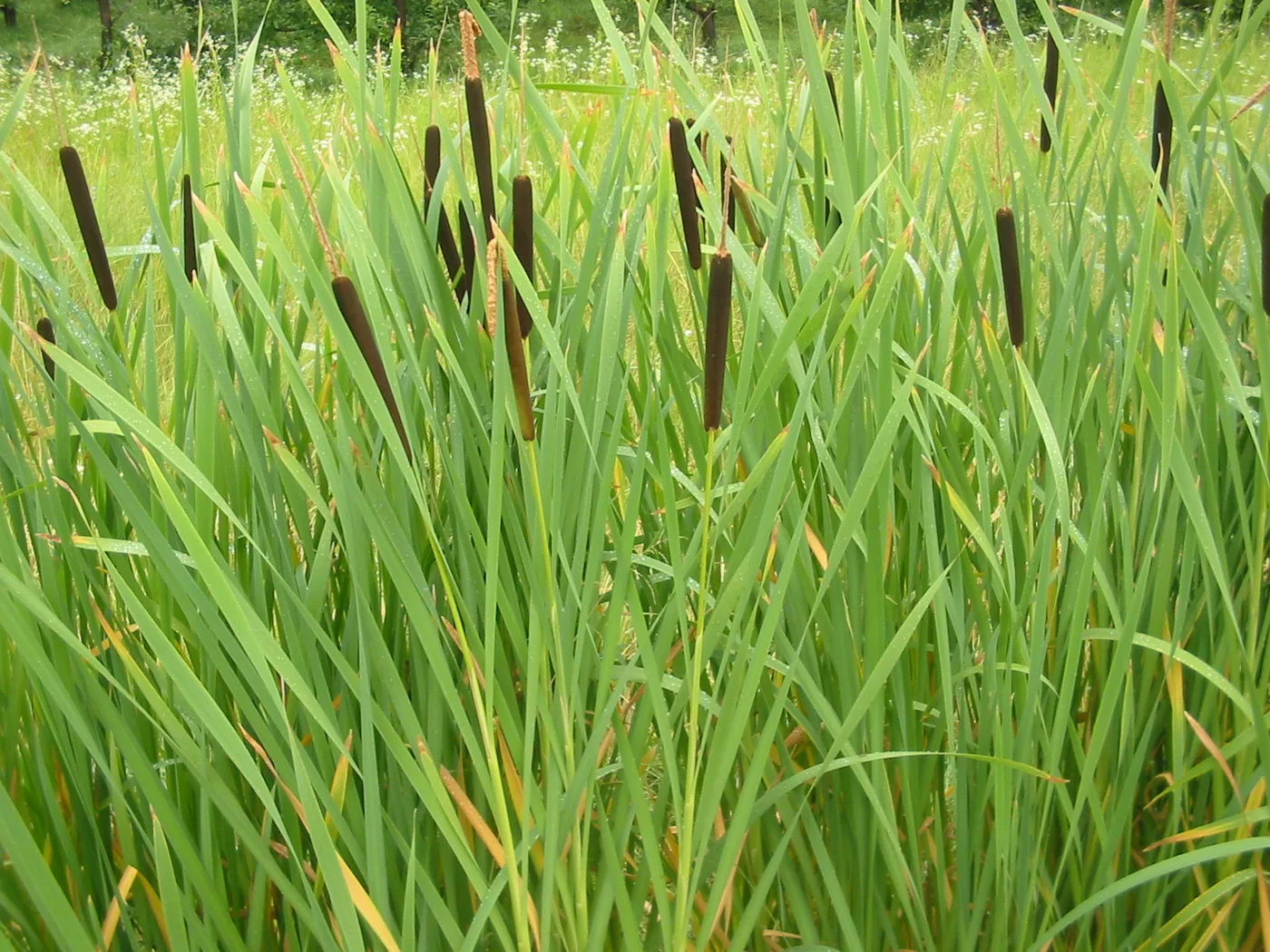
The cattail reaches 3 meters (10 feet) in height and is notable for its soft, fuzzy brown seed head that eventually disintegrates into fluffy material that blows away in the wind and floats on the water. The plant also spreads through its thick roots, which creep along the bottom of shallow lakes and streams. Its leaves are long, erect, and sharply pointed.
Special significance
In Bible times, as now, the leaves of cattails were used for baskets and mats. The thick roots are edible, as are the pollen and the young green stalks. The cattails of Exodus are famous as the plants among which the mother of Moses hid her son in his little floating basket.
Translation
Most kinds of cattail are found in Europe and North America, where the leaves are used for mats and chair seats. Some Typha species in India (Typha elephantina) are used for making paper and ornaments. Translators who live near rivers may have other reed-like plants that can be used, keeping in mind that there are four reed-like plants mentioned in the Bible (see also Papyrus, Reed (common reed, giant reed), and Rush (bulrush, sedge). In EXO 2:3; EXO 2:5 a number of English versions use the generic word “reeds” (RSV, NRSV, NIV, LB, REB, NJB, NJPSV). GW has “papyrus plants,” but the experts prefer to see papyrus associated with the Hebrew word gome’. In communities that are unfamiliar with waterside vegetation, generic expressions such as “tall grass” (GNB, CEV) or “tall stalks of grass” (NCV) may be effective. The basic options for rendering suf in Exodus and Isaiah are:
1. a local grass that grows in streams and rivers;
2. a generic word such as “grass”;
3. a descriptive phrase such as “tall grass.”
The word suf has a different sense in JON 2:6 (5). In this passage the plants are living in the water without roots or are perhaps rooted in the bottom of a shallow sea. So translations typically use “seaweed” (GNB, CEV, NLT, GW, REB), a plant with long, grass-like leaves that is often not attached to the soil under the sea.
If specific transliterations of suf are needed, adaptations of the following major language words could be considered: Arabic bardi, but, dadi, tifa; French jonc, marset; Portuguese murao, tabua; and Spanish aseña, enea, espadaina, españada, junco, macio, totora, tule espidilla.
The Hebrew expression yam suf (literally “sea of reeds”) has been translated somewhat inaccurately by the Septuagint translators and many others as “Red Sea.” A Handbook on Exodus recommends following the Hebrew, which is literally “Sea of Reeds,” or the modern equivalent “Gulf of Suez” as in GNB, unless there is a strong tradition in the receptor culture for “Red Sea.” If “Red Sea” is used, then a footnote should be added, giving “Sea of Reeds” as the literal meaning of the Hebrew text.