Discussion
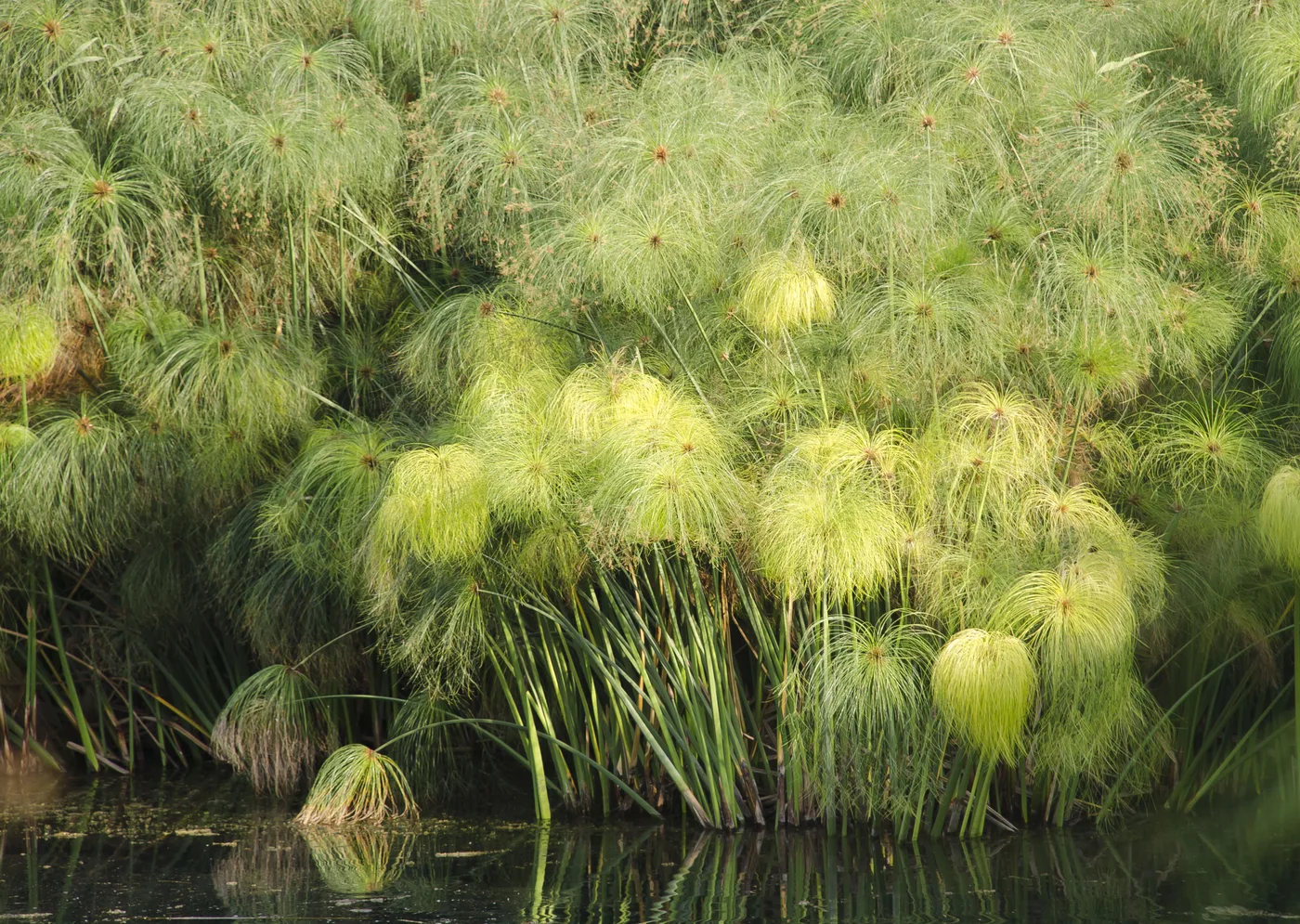
Although there has been considerable debate among botanists as to the identity of the various types of reed in the Bible, there is general agreement that the Hebrew word gome’ refers to the Papyrus Cyperus papyrus, based on etymological and practical grounds. As for the Hebrew word ’eveh, the phrase “skiffs of ’eveh in JOB 9:26 suggests that it refers to papyrus, since boats in Egypt were made of papyrus, apart from those made from wood. However, versions are divided between “papyrus” (NIV) and “reed” (RSV, REB) in this passage.
Description
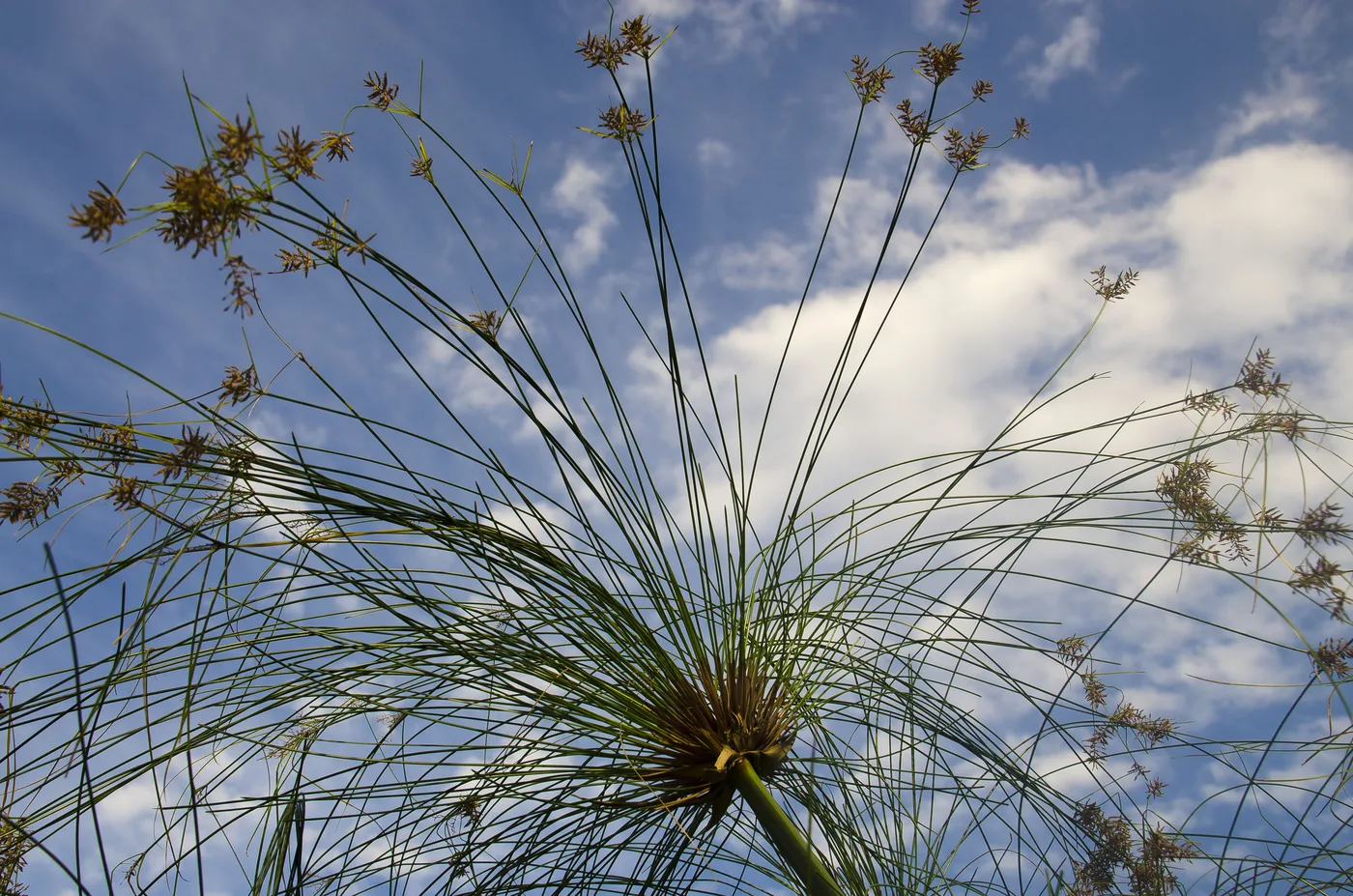
Special significance
Papyrus was the most versatile grass in the Ancient Near East. In Egypt it was used to make boxes, mats, ropes, and especially paper. Perhaps its use in boats came to the mind of Jochebed when she wanted to save her infant son Moses from the wrath of the Pharoah (EXO 2:3). Job’s companion Bildad uses papyrus as an example of a plant that needs water, and further as a slam at Job suggesting he must have sinned JOB 8:11). ISA 18:2 refers to “ambassadors by the Nile, in vessels of papyrus” as emblems of the great political power of Egypt. Poor people also used papyrus for barrels, huts, sandals, and clothing. Perhaps surprisingly, papyrus was not usually used for baskets. The baskets of the Egyptians, like those in sub-Saharan Africa today, were made of coiled construction using a core of date palm leaflets, fibers, or the split midrib, with a fiber wrapped around the core, like a guitar string.
Translation
There are over six hundred kinds of Cyperus growing in tropical and warm climates throughout the world, but many do not resemble the papyrus. For example, the tigernut sedge, found in West Asia and Africa and producing a tasty tuber (also called chufa or Zulu nut), belongs to the Cyperus genus. So also do the coco grass and several other types used for mats throughout Asia. The papyrus proper is now rare in Egypt but rampant in northern Uganda, where it is called sudd.
Most of the contexts where gome’ is found are rhetorical (EXO 2:3 being the exception), opening the way for translators to substitute local equivalents. However, if the original plant name is replaced, it is usually good to document the original in a footnote, especially where the word identifies a particular area, as in ISA 18:1, where papyrus vessels are identified with “Ethiopia.” In EXO 2:3 the mother of Moses did not use “bulrushes” (RSV, KJV) but papyrus, nor did she make a “basket” (RSV) but a “box” (tevah in Hebrew). If there is a word for “box,” it should be used. Otherwise, the general word for “basket” can be used, and a type of strong grass used for baskets should be used for the material. The following options are available for gome’:
1. use a local strong grass;
2. use a descriptive phrase such as “strong grass”;
3. use a generic word for “grass”;
4. leave the plant implicit as part of the verb “weave” or the noun “box/basket” in EXO 2:3;
5. use “rush” (REB), “papyrus reeds” (LB), or “reeds” (GNB).
If transliterations are needed for papyrus, some possibilities are French jonc and Portuguese/Spanish papiro.
ISA 35:7: The last two lines of this verse read “the haunt of jackals shall become a swamp, the grass shall become reeds and rushes [gome’ ].” Here translators must have a set of words for grass since these two parallel lines need to show a progression: what was once desert (a haunt of jackals) will become a swamp; and what was once ordinary grass will become grass growing in water.