Discussion
There are over 450 species of grass in the Holy Land, and it is unlikely that the Hebrew, Aramaic, Greek, and Latin words above refer to particular species. They are probably generic words that have at one time or other, or in one place or another, referred to various kinds of grass.
According to Zohary, in GEN 41:2; GEN 41:18 the Hebrew word ’achu (“reed grass”) refers not to a kind of grass but to “damp swampy land used for grazing” (page 127; see KJV “meadow”). However, JOB 8:11 seems to speak specifically of some kind of plant (parallel to papyrus), stating that ’achu cannot grow where there is no water.
The Hebrew word chashash in ISA 5:24 is used for dry grass, parallel to stubble, referring to the wicked who will be burned up. In ISA 33:11 the futile plans of the wicked are likened to chashash, again parallel to stubble.
The eight occurrences of the Hebrew word yereq (“green”) in the Old Testament refer to vegetation. Most of them occur in a phrase such as yereq ‘esev (rendered “green plant” in GEN 1:30; GEN 9:3) or yereq deshe’ (rendered “tender grass” or “green herb” in 2KI 19:26; PSA 37:2; ISA 37:27). However, in three passages yereq stands alone (rendered “grass,” “verdue,” or “green thing” in EXO 10:15; NUM 22:4; ISA 15:6).
The Hebrew word deshe’ is sometimes translated “grass.” It usually occurs in rhetorical contexts, where it is often parallel to chatsir, yereq, or ‘esev.
The Hebrew word ‘esev occurs thirty-three times in the Bible and is translated by RSV as “plant” in twelve of them, as “grass” in twelve, as “herb” or “herbage” in five, and as “vegetation” in four. Since there may be languages that have no generic word like “plant,” they may be able to use their word for “grass” or “growing things” in many of these passages when it is appropriate.
There are a number of words for “pasture,” the grassy fields in which sheep, goats, and cows like to graze. Hebrew has not less than five words: apart from mir‘eh, listed above, there are also migrash (114 times, mostly in Joshua and 1 Chronicles), dover (ISA 5:17; MIC 2:12), kar (PSA 37:20; PSA 65:14; ISA 30:23), and nawah (11 times).
Apart from all of the above, there is also the Hebrew word teven, which is translated “straw”—dried grass used for bricks and as bedding for animals. For example, this word occurs in GEN 24:25; GEN 24:32, but translators need to be aware that “straw” for the camels was not for the camels to eat but rather was put on the ground to absorb the urine of the animals.
There are two Hebrew words that are usually translated “fodder” (that is, animal food) or “provender”: belil (JOB 6:5; JOB 24:6; ISA 30:24) and mispo’ (GEN 24:25, GEN 24:32; GEN 42:27; GEN 43:24; JDG 19:19). These words probably refer to some type of grass.
In the New Testament the Greek word chortos occurs fifteen times and is usually translated by RSV as “grass.”
The Greek word lachanon occurs four times in the New Testament. It is a generic term for garden plants that can be translated according to its context. In MAT 13:32; MRK 4:32 the mustard seed grows to become bigger than all the lachanon (“shrubs”) of the garden. The Pharisees tithe mint, rue, and every lachanon (“herb”) in LUK 11:42. The weaker brother of ROM 14:2 eats only lachanon (“vegetables”).
The Greek word botanē is another generic term. It is translated “vegetation” in HEB 6:7.
In the Deuterocanon the Greek word chloē means “young green growth” (SIR 40:22; SIR 43:21). This same word occurs in the Septuagint to translate the Hebrew word deshe’ (2SA 23:4; 2KI 19:26; JOB 38:27; PSA 23:2; PSA 37:2).
Description
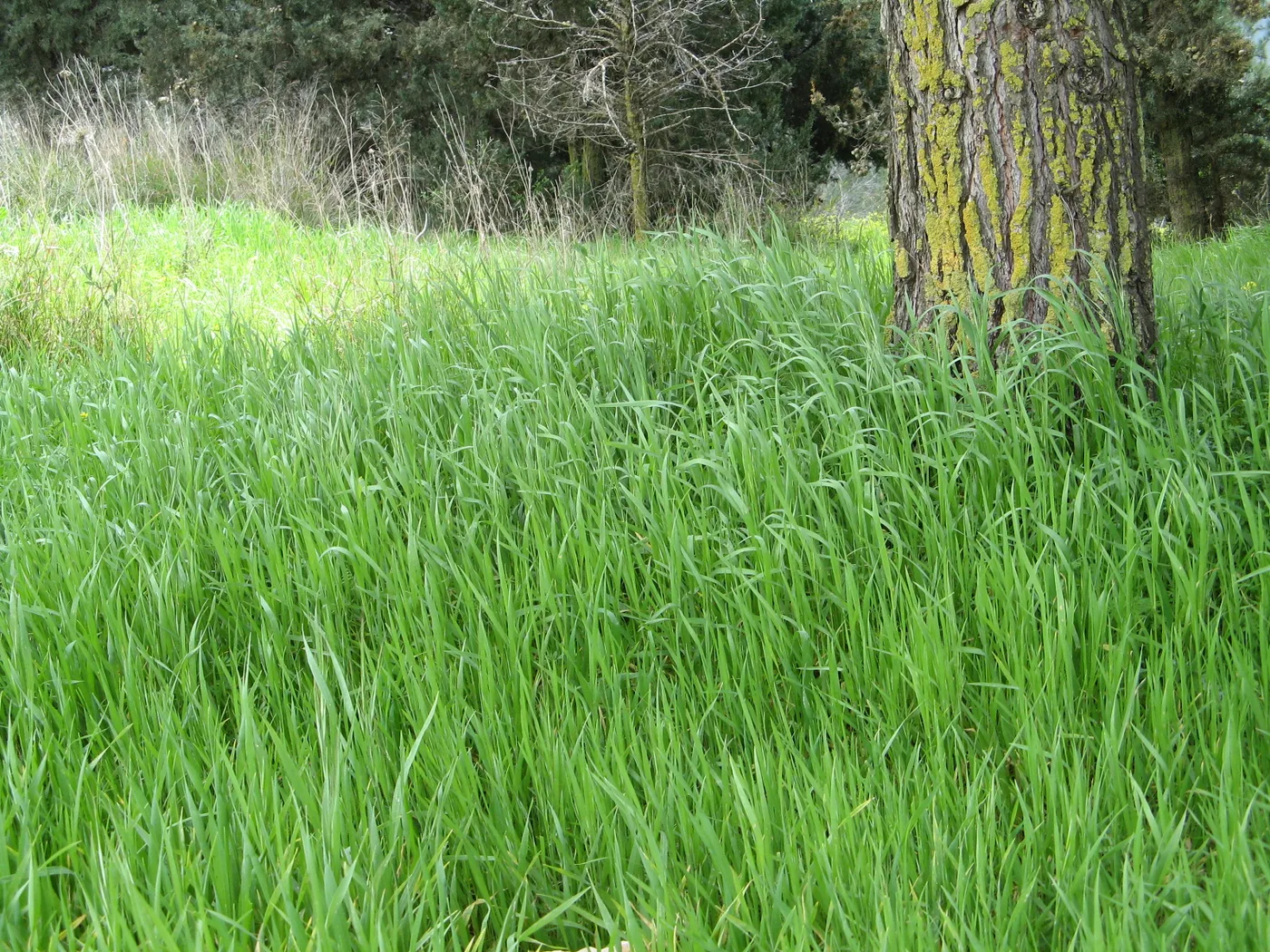
Grass is so common to most translators that no description is needed. However, for translators who live above the Arctic Circle or in inhospitable deserts, the grasses of the lands of the Bible may cause problems. A common problem is having too many specific words and no generic one. I recall a translation team in Niger (Tamasheq) that really struggled with “sat down on the green grass” in MRK 6:39, because the only grass they knew (appearing in the short rainy season), was not something anyone would want to sit on. Grass can be described as being less than a meter (3 feet) high, with narrow, green, upright leaves, usually growing in bunches or clumps.
Special significance
Translation
In the case of some African languages, a word translated “grass” actually refers to “unexploited vegetation” in contrast to plants used for food, medicine, and utensils. It is possible that such a distinction was present in Hebrew as well, but at this point we don’t know about it. Before translating, it will be important to investigate how the local people categorize the plant world. Once the local taxonomy is known, the translators can decide how much or how little of it they want to use, depending on their general principles of accommodation in the translation as a whole.
Where possible, the Hebrew word deshe’ should carry the meaning of new growth or fresh sprouts of a plant. Since it usually occurs in rhetorical contexts and is often parallel with other references to grass, the translator needs to think of pairs or triplets of words that refer to grass and grass-like plants.
GEN 1:11 a: “Let the earth put forth vegetation [deshe’ ].” On the basis of this verse’s parallelism with verse 20, I support the majority view here that there are two categories with a generic introducer (see the Plants for weaving and building on this section). The translator needs the most general word for plants here to render deshe’.* If there is no generic word available, a phrase such as “things with leaves” or “sprouting things” is appropriate. As a last resort, one could simply omit the generic term and translate the specifics.
GEN 1:11 b: “Plants yielding seed.” It is difficult to know if the Hebrew phrase here (‘esev mazri‘a zera‘) is talking about plants whose “fruit” is a seed, like rice, or any kind of plants that have seeds, including tomatoes, peppers, grapes, eggplants, and so forth. The English versions stay ambiguous; for example, GNB “those that bear grain,” CEV “grain,” NCV “some to make grain for seeds,” NIV “seed-bearing plants” (also NJB, NJPSV; similarly NLT, GW), and REB “plants that bear seed.” “Grain” (equivalent to “corn” in British English) may be too narrow. In either case, this category is set off against what follows, namely, fruit-bearing plants like apples and mangoes.
GEN 1:11 c: “Fruit trees bearing fruit in which is their seed.” The issue here is whether the Hebrew phrase ’asher zar‘o vo (“in which is their seed”) is a redundant expression like “of the air” after birds, or whether the phrase actually adds information. GNB and CEV take it as redundant (GNB “those that bear fruit,” CEV “fruit trees”). Others seem to feel it necessary to retain this phrase (for example, NCV “others to make fruits with seeds in them,” and NJB “fruit trees … bearing fruit with their seed inside” [similarly NJPSV ]).
GEN 1:11 d: “Each according to its kind.” GW says “each according to its own type.” There seem to be three interpretations of the Hebrew phrase here in the English versions:
1. Some take it as emphasizing the multiplicity of plant types; for example, GNB and CEV say “all kinds of plants” (similarly NAB, NJPSV).
2. Some seem to focus on the categorization of plants; for example, NIV says “according to their various kinds,” and NJB has “each corresponding to its own species.”
3. Some focus on the reproductivity of plants; for example, NCV says “Every seed will produce more of its own kind of plant” and NLT has “The seeds will then produce the kinds of plants and trees from which they came.” Compare REB, which reads “each with its own kind of seed.”
A major theme of the writer in GEN 1:11 seems to be the orderliness—the categories and subcategories—of creation. This supports NIV and NJB. But the repeated use of “seed” indicates that the writer is also interested in the regularity of genetic laws. Echoing this theme, Deuteronomy includes laws strictly forbidding the mixture of different kinds (“seeds” in some languages!) of plants in farms and fibers in clothes. Christ added his own version to this Hebrew concern when he said, “Are grapes gathered from thorns, or figs from thistles?” (MAT 7:16). Possible models for GEN 1:11 are:
1. Let the earth be covered with plants. Let there be plants with seeds [or, a local subcategory] and trees with fruit [or, a local subcategory]. Let each one have a different kind of seed.
2. Let different kinds of plants sprout from the ground and cover the whole earth. Let there be grass, shrubs, and trees [or, plants with seeds and trees with fruit; or, grain, vegetables, and fruit trees]. Let each kind produce its own.
Translators, after carefully studying the categorization system of their own language, should consider which of the two basic structures of this verse matches their own best. It is quite possible that the three-way division taken by NLT and some commentaries would fit the local system better. If so, there is no harm in following it.
Once translators have investigated their local taxonomy, they must decide whether to use it or to try to express the Hebrew categorization. In the absence of middle level generic terms, translators could say “plants like rice” and “plants like mangos,” though this carries the hazard of implying that the original audience had rice or mangos.
The Hebrew categorization is more typological than strictly logical or scientific, so it leaves us with overlap and ambiguity. Probably the most important thing that the writer intends to show is the orderliness of God’s creation.
2KI 19:26: The last two lines of this verse read “like grass [chatsir ] on the housetops; blighted before it is grown” (also ISA 37:27; similarly PSA 129:6). These lines gives us a picture of a house with a flat roof where dust could settle, forming a fertile but shallow environment for the germination of grass seeds. However, the grass was doomed to wither and die quickly because of the lack of moisture and soil. There is a textual problem with the last line. HOTTP backs the MT, which reads “blighted/scorced before it rises” (shedefah lifne qamah). It gives a “C” rating to the MT over against the conjecture, which reads “blighted/scorched before the east wind” (shedefah lifne qadim). The conjection is followed by GNB and REB. HOTTP concludes that the copyist(s), lacking sufficient knowledge of Hebrew, didn’t understand this line and guessed that it might have meant “scorched by the east wind,” which is also very logical. The consensus appears to follow the MT (so RSV, NIV, LB, GW). NJPSV also follows the MT by saying “blasted before the standing grain,” which makes no sense at all in the context.