Discussion
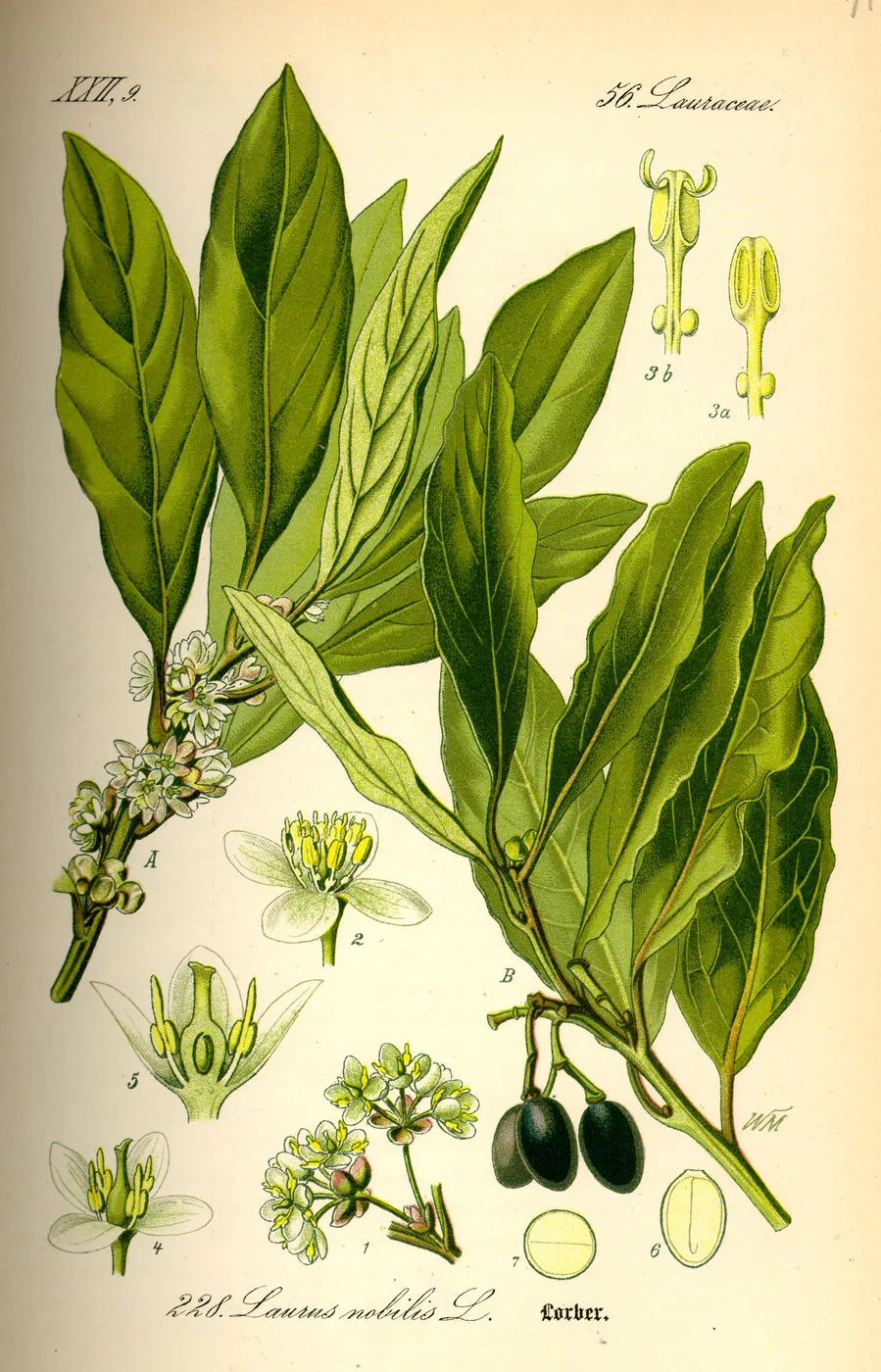
The Laurel Laurus nobilis is the source of bay leaf used in European cooking up to today. It must have been common in Israel in biblical times, and was used for oil, as a spice in food, and in medicine. It has a fresh, pleasing smell. It was abundant in Carmel, where it is plentiful to the present, and on the other mountains, Tabor, Gilead and Hermon. However, we only have two very debatable references to the laurel tree in the Bible. One is ISA 44:14, which refers to the making of idols: “… he plants ’oren [‘cedar’ in RSV ] and the rain nourishes it.” The other is PSA 37:35, where the Hebrew word ‘oritz may not refer to a plant at all. In ISA 44:14 the letter n in the Hebrew word ’oren was marked as suspicious by the Masoretes, leading later scholars to take the root ’ar as a reference to ’erez (“cedar”). However, the reading ’oren is probably correct.
Although ’oren is used in modern Hebrew for the pine tree, the Aramaic translation, Targum Jonathan, has ’aranye in this passage, the Arabic equivalent of which is ’ar. Post-biblical writers use the name ’ar for “laurel.” The botanist Thompson associates the Akkadian word ’eru with the laurel. Zohary follows this line of thinking, and assumes that the biblical writers could not have ignored such a useful and lovely tree, so he implicitly advocates using it in ISA 44:14. Similarly, the botanist Moldenke favors laurel for ‘oritz in PSA 37:35 (RSV “overbearing”), but no version has followed that. KJV ’s “ash” for ’oren in ISA 44:14 is unsupported, although a type of ash known as the Syrian Ash Fraxinus syriaca is fairly common in Israel and may have been known in Bible times.
Description
The laurel reaches a height of 15 meters (50 feet) and has dark green leaves. The flowers are small, greenish white, and produce a one-seeded fruit the size of a small grape. Laurels are found in thickets and woods from the Mediterranean coast to the hills of Judea and Galilee.
Special significance
In Bible times wreaths (stemma in Greek) were made from bunches of laurel leaves used to honor winning athletes, and they were also worn by the Roman emperors. Hence it is quite possible that the garlands mentioned in ACT 14:13 were of laurel leaves. The victory wreaths referred to in 1CO 9:25; 2TI 2:5; and 1PE 5:4 would have been made of laurel leaves. Garlands are also mentioned in PRO 1:9 and PRO 4:9 (liwyah in Hebrew). If in fact the psalmist intended to refer to the laurel in PSA 37:35, it is used there as a symbol of the ostentatious prosperity of the wicked. (See also the discussion in WTH, Wreath, crown, Garland.
Translation
The laurel is found throughout the Mediterranean region and southern Europe. It belongs to a large family of trees called Lauraceae that has hundreds of species scattered about the tropical and warm climates of the world, especially in Southeast Asia and Brazil. Cinnamon trees, avocado trees, and magnolias are well-known trees from this family. Close relatives of the true bay tree are only found in the Azores (Laurus azorica). In places where the laurel/bay tree is known, it may be used in ISA 44:14. If not, a transliteration from a major language is recommended, such as laurier (French), loureiro /louro (Portuguese), laurel (Spanish). However, the translation of ’oren will depend partly on what has been done with the other trees mentioned in ISA 44:14. If transliterations are used, they should be used throughout. If local species are substituted, they should be used throughout.