Description and usage
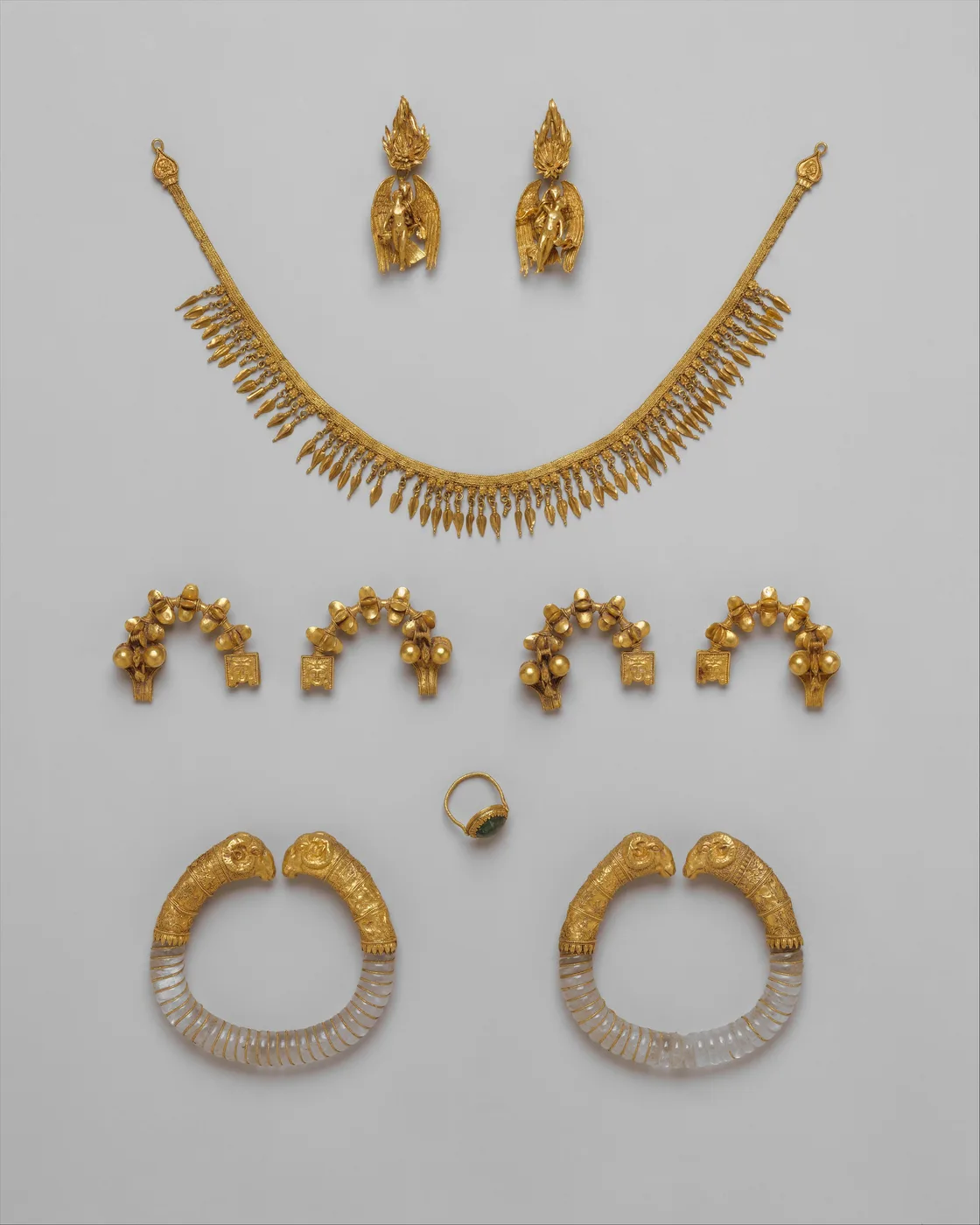
Jewelry was personal ornamentation worn on various parts of the body, often made with precious metals and gems. Items of jewelry could be worn on various parts of the head and face, around the neck, on all parts of the arms and fingers, and on the ankles. While jewelry was worn mostly by women, there were also certain items that were worn by men.
Translation
“Jewelry” may be rendered “things to make someone look beautiful” or “things with which someone tries to appear attractive.” “Gold jewelry” may be referred to as “pretty things made out of gold.”
The Hebrew word kli is actually a general term meaning “object” or “thing.” In the references above, a partial list is given of places where kli is usually accompanied by a modifier such as “gold” or “ornamental.” These occurrences may be taken as referring to jewelry in a generic sense and translated simply as “jewels” or “valuable objects.”
REV 17:4; REV 18:16: Instead of saying that the woman was “covered with gold ornaments, precious stones, and pearls” (REV 17:4 in GNT), it may be far more appropriate to say “she wore many gold ornaments, precious stones, and pearls” or “many gold ornaments, precious stones, and pearls were fastened to her clothes.” The Greek text in these two passages has no word for “jewelry” but only mentions the materials from which the jewelry was made. CEV may serve as a good model: “she wore jewelry made of gold, precious stones, and pearls.”
The list in these verses contains over 20 items, including jewelry and clothing. Many of the items occur only once in Scripture, and their exact meaning is unclear. In these verses some translations do not try to find separate words for each item of jewelry but rather use a general term for jewelry indicating where it is worn; for example, CEV has “When that day comes, I will take away from those women all the fine jewelry they wear on their ankles, heads, necks, ears, arms, noses, fingers, and on their clothes. I will remove their veils, their belts, their perfume, their magic charms, their royal robes, and all their fancy dresses, hats, and purses.”
There is an obvious connection to foreign cults in the origin of some of the jewelry. The “sun” and “moon” (referred to by the Hebrew words rendered “headbands” and “crescents” by RSV in verse 18) were worshiped in Semitic religions, and the “amulets” of verse 20 probably had their origin in a magical or religious function. However, just as this foreign religious connection was not specifically condemned in ISA 3:2; ISA 3:3, so it is not part of the focus here. The focus is on the false sense of power and pride that is going to be inverted because it is based on injustice.
The following comment by Watts in his commentary on Isaiah is worth quoting. “It is impossible now to gain a clear picture of the articles named … Fashion then as now changes rapidly and tends to name its articles in ways that defy rational definition. … Hartmann … has shown that LXX [the Septuagint] simply made a list of such articles from his own period to serve as a translation which many a translator has done in similar circumstances since then” (page 46).
The following discussion goes through the list item by item. Words in brackets are the translation of NRSV followed by that of GNT for each Hebrew word.
Verse 18
‘Akasim (“anklets,” “ornaments they wear on their ankles”): The “anklets” can refer to little chains or ornaments attached to shoes, legs, or ankles. A related Hebrew verb (translated “tinkling”) was used in ISA 3:16. See Bracelet, armlet, anklet below.
Shvisim (“headbands,” “[ornaments] on their heads”) and saharonim (“crescents,” “[ornaments] on their necks”): The “headbands,” as the word is used in later Hebrew, were made of gold or wool thread and hung from a headpiece worn on top of the head. However, many scholars think that the word applies to sun-shaped, disk ornaments (that is, “little suns, sunettes”) and is intended as a pair with the moon-shaped ornaments, the “crescents.” This later interpretation is preferable. FRCL has “headbands” for the first word, but with a footnote saying “Or jewels in the shape of the sun.” For “crescents,” NCV has “necklaces shaped like the moon.” GECL has “suns and half-moons, which they wear on the neck.” Another possible rendering is “little pendants/jewels/ornaments [shaped like/in the shape of] the sun and half-moon.” We do not know where “little suns and half-moon ornaments” were hung since they could conceivably be added to footwear, hands, bracelets, necklaces, headgear, clothing, or to all of these places. Archaeologists have found necklaces with these ornaments. If they are translated as items hanging on necklaces then they should not be tightly grouped with “anklets.”
Verse 19
Ntifoth (“pendants,” combined by GNT with saharonim in verse 18): The “pendants” probably refer to tear-drop or drip-shaped ornaments since the root word in Hebrew is used with liquids like honey and wine, and is not a general word for “hanging.” TOB has a note saying “Literally drops, most likely pearls.” These “pendants” could be worn on a necklace made with pretty stones or glass. FRCL and NCV use “earrings.”
Sheroth (“bracelets,” “[ornaments] on their wrists”) For this Hebrew word, “bracelets” is not recommended as a translation. In later Hebrew, the word meant a neck-strap used for domesticated animals. It may be related to a word for “chain” and probably means “necklace” or “neck cord” here. If so, it would make a fitting pair with the bead-droplets immediately before it. Thus “beads and necklaces” or “droplets and neck cords” is preferred for the first two words in this verse.
R‘aloth (“scarfs,” “veils”): The last item in this verse is less problematic. The Hebrew word r‘aloth refers to cloth used to cover the face. NCV and GNT have “veils.” See Veil.
Verse 20
P’erim (“headdresses,” “hats”): The word “headdresses” is a close approximation in English to the Hebrew word here. The word probably refers to head decorations, perhaps often with a flower motif, either as a hat, turban, or crown. NCV has “scarves,” and REB says “headbands.” General words for (fancy) hats or special sashes wrapped as headgear by women around their heads is good here, but note the “turbans” in verse 23. NJB has “diadems,” the ornamental head cover worn by queens and princesses. See also Waistband, sash, belt.
Ts‘adoth (“armlets,” combined by GNT with the next three items as “the magic charms they wear on their arms and at their waists”): The “armlets,” which were metal bands of decoration worn on the arm, are known from 2SA 1:10 (see Bracelet, armlet, anklet below). These may have signaled persons belonging to royalty or the ruling class, according to some interpretations based on ancient pictures from the Assyrian court. The root of the Hebrew word ts‘adoth refers to a “step, pace,” so some scholars have thought that these ornaments were originally anklets (NCV “ankle chains”; similarly NJB). However, “armlets” is recommended as less speculative than “anklets.” In Isaiah’s description here, they are women’s ornaments. FRCL has “little chains.”
Qishurim (“sashes”): The “sashes,” or girdles, refer to bindings used on outer garments. They could be decorated with beads. NCV opts for a longer descriptive phrase with “cloth belts worn around their waists.” REB has “necklaces.” (It may be worth mentioning that a translator should never list the same item twice within one inventory!) see also Waistband, sash, belt.
Batey nefesh (“perfume boxes”): The Hebrew here is literally “life houses” and may refer to small cylinders that could hold written incantations. TOB explains that they were to provide a magic protection to those wearing them, and gives 1SA 25:29 as a possible reference. This interpretation is recommended, and the translator should use “talismans” (NJPSV) as a model, or follow the GNT. FRCL has a word that could be translated “magic medicine.” This item will form a semantic pair with the next one.
Lchashim (“amulets”): The Hebrew here is literally “whispered charms” and may refer to any kind of little article that is thought to carry magic power. FRCL has “good-luck charm.” The purpose of mentioning these items is not to condemn pagan magic directly but to expose the pride that is placed on wealth and power. So these amulets signify amoral, wealthy power.
Verse 21
Taba‘oth (“signet rings,” “rings they wear on their fingers”): As the renderings of NRSV and GNT indicate, it is possible to understand these rings either as signet rings (NIV, REB, NJPSV, NCV) or simply as decorative jewelry (GECL, SPCL, NASB, NJB); see the discussion under Seal, signet ring, ring. The choice of the translator will be determined by considering Isaiah’s intended audience here, which is “the daughters of Zion” (ISA 3:16). Since it is unlikely that women wore “signet rings,” with the implication that they wielded authority, then “rings” or “finger rings” is the better rendering.
Nizmey ’af (“nose rings,” “[rings] in their noses”): “Nose rings” are an ornament that seems to be associated with women (GEN 24:47; EZK 16:12; HOS 2:15). Men may have worn similar rings in their ears (GEN 35:4). Some of these “nose rings” and earrings were associated with pagan cults (GEN 35:2; GEN 35:3; GEN 35:4). In some cultures for women to wear “nose rings” would appear to be a strange custom. If a literal translation would cause too much of a distraction, a translator may generalize and speak of jewelry worn on the head as opposed to that worn elsewhere on the body. See Earring, nose ring below.
Verse 22
Machalatsoth (“festal robes,” “fine robes”): The meaning of this Hebrew word is uncertain. It may be connected with the word for “waist.” Perhaps these garments were fine coats with sleeves. Other possible meanings are “skirts,” “slips,” “underwear,” and “loincloths” (suggested by Sheffer, page 546). However, these last meanings do not fit as well with the next two words. “Fancy coats” may be the most probable meaning here. REB has “fine dresses” and NCV “fine robes.” NJB “party dresses” is an attempt to find a modern equivalent. See also Outer garment, cloak, mantle, robe.
Ma‘atafoth (“mantles,” “gowns”): The “mantles” were probably outer garments that could be wrapped around the shoulders and over the head. Perhaps they were made of a heavier material than the next item. This is the only place where the word occurs in the Hebrew Bible. FRCL has “capes.”
Mitpachoth (“cloaks,” “cloaks”): The “cloaks” appear to be a specific covering worn by women. This Hebrew word also occurs in RUT 3:15. Women were able to cover their heads and shoulders with these garments. NJPSV gives a good model for translating this word in English with “shawls,” which is a covering normally used by women. They were sometimes used for carrying possessions, as in the Ruth example. See also Outer garment, cloak, mantle, robe.
Charitim (“handbags, purses”): The last item in this verse is slightly different from the garments mentioned here. The “handbags” were bags used for carrying money or other small items. Perhaps these “purses” were grouped with shawls because both could be used for carrying things. See Bag, sack, money bag, purse.
Verse 23
Gilyonim (“garments of gauze,” “revealing garments”): This Hebrew word probably refers to a thin, fine piece of cloth that can be seen through, so GNT has “revealing garments.” Some scholars have suggested that the word refers to “mirrors” (NCV, TOB) that could be carried in the purses of the previous verse. However, “fine cloth” is more probable.
Sdinim (“linen garments,” “linen handkerchiefs”): The “linen garments” were sheets of linen. They could be used to sit or recline on, or as curtains, or as clothing to wrap oneself in (“wrapper”). FRCL has “fine blouses.” “Linen handkerchiefs” is another possibility if it can be understood as a piece of clothing. See also Shirt, tunic.
Tsnifoth (“turbans,” “scarves”): This Hebrew word refers to women’s head coverings. The head covering may have been able to serve as a veil as well. FRCL has “scarves.” One possible rendering is “fine clothes wound around the head,” unless such a description is too heavy or long-winded in the context of a description that aims at being comprehensive rather than precise and technical. See also Headdress, turban, hat.
Rdidim (“veils,” “long veils they wear on their heads”): This Hebrew word probably refers to a veil of fine quality. It was able to cover the face. It probably refers to the same kind of veil as those mentioned in GEN 24:65 and GEN 38:14, GEN 38:19, but it is a different word, most likely referring to a garment of finer quality. See also Veil.