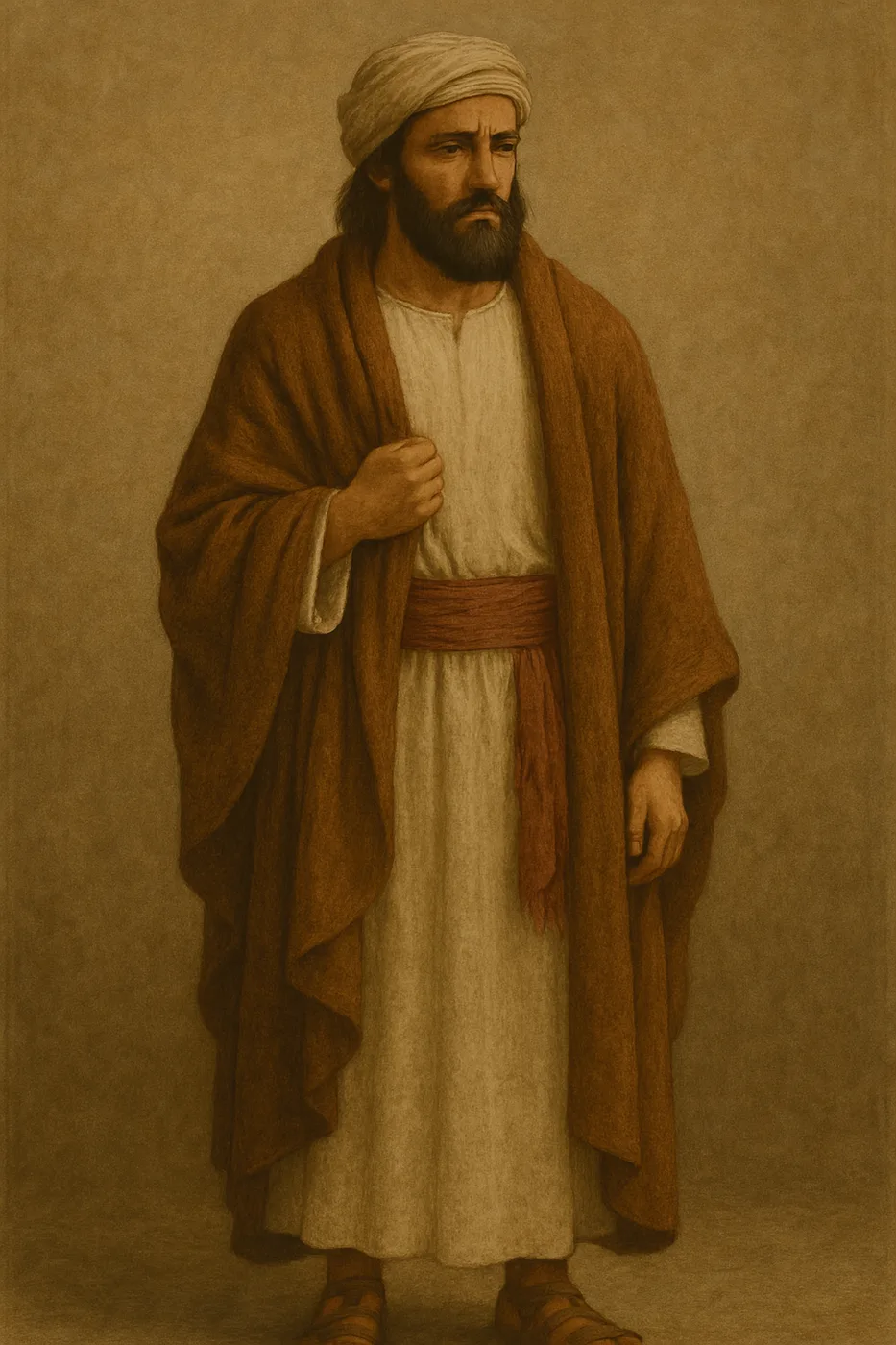
Description and usage
The cloak was a long, flowing outer garment reaching to the feet. It was generally a loose-fitting cloth that was draped around the body and held in place in the middle by a sash wrapped around the waist (see Waistband, sash, belt) or some means of fastening such as pins or buttons. The cloak was worn at all levels of society, including also priests and other religious leaders. It served more purposes than just an outer covering. Women sometimes carried bowls or other implements or grain (see EXO 22:26) in its folds. For poorer people it also served as a covering when sleeping. For this reason Jewish law prohibited taking a person’s robe overnight as a guarantee (EXO 22:26 [25]).
For the robe of the High Priest, see Robe.
Translation
The outer garment is referred to by a number of Hebrew and Greek terms that are not easily distinguished. The choice of an equivalent for these terms relating to “outer garment” will depend largely upon the specific context and the usage in each receptor language. The most common equivalent is usually a term meaning “coat.” In some passages the long robe is culturally significant as an indication of high social status and dignified occupation or activity.
Some Bible passages refer to people tearing their clothes. This was done as an act of grief (see GEN 37:34; JOS 7:6; 2SA 1:11; 2SA 3:31; 2SA 13:31; 2KI 5:7; EZR 9:3; EZR 9:5; EST 4:1; JOB 1:20; JOB 2:12). Translators may expand the expression for tearing clothes; for example, in JOB 1:20 a GNT has “Then Job got up and tore his clothes in grief,” where the addition of “in grief” makes clear the purpose of the gesture. It is also possible to translate the meaning of the gesture only; for example, “Job stood up full of grief” or “Job got to his feet, his heart broken.” Where there is a common local custom used to display grief, it may be helpful to keep the biblical custom in the text and to compare it to the local custom in a note; for example, the note may read “This is equivalent to the practice of painting the face to show that the person is in mourning.”
RUT 3:15: The Hebrew word mitpachath would normally be expected to mean a kind of “veil” (KJV; compare ISA 3:22). In this context, however, it is clear that a veil of thin material would not have been strong enough to carry the weight of the barley. Older translations understood it to be a kind of “mantle” (RSV), while modern translations prefer something like “cloak” (GNT, REB). Others look for a more modern equivalent, such as “cape” (CEV) or “shawl” (NJPSV, NCV).
ISA 3:22: Sheffer suggests translating the Hebrew word machalatsoth (plural of machalatsah) in this verse as “loincloths.” It is probably better to say “cloaks” or “shawls.”
1TI 2:9: The Greek word himatismos in this verse is the general word for garments of any kind, but since women are being referred to, then the word “dresses” (GNT) will fit this context if “dresses” are the natural wear in a translator’s culture. However, in cultures where women wear some other type of clothing, translators should use a more general word, as the Greek does.