Description
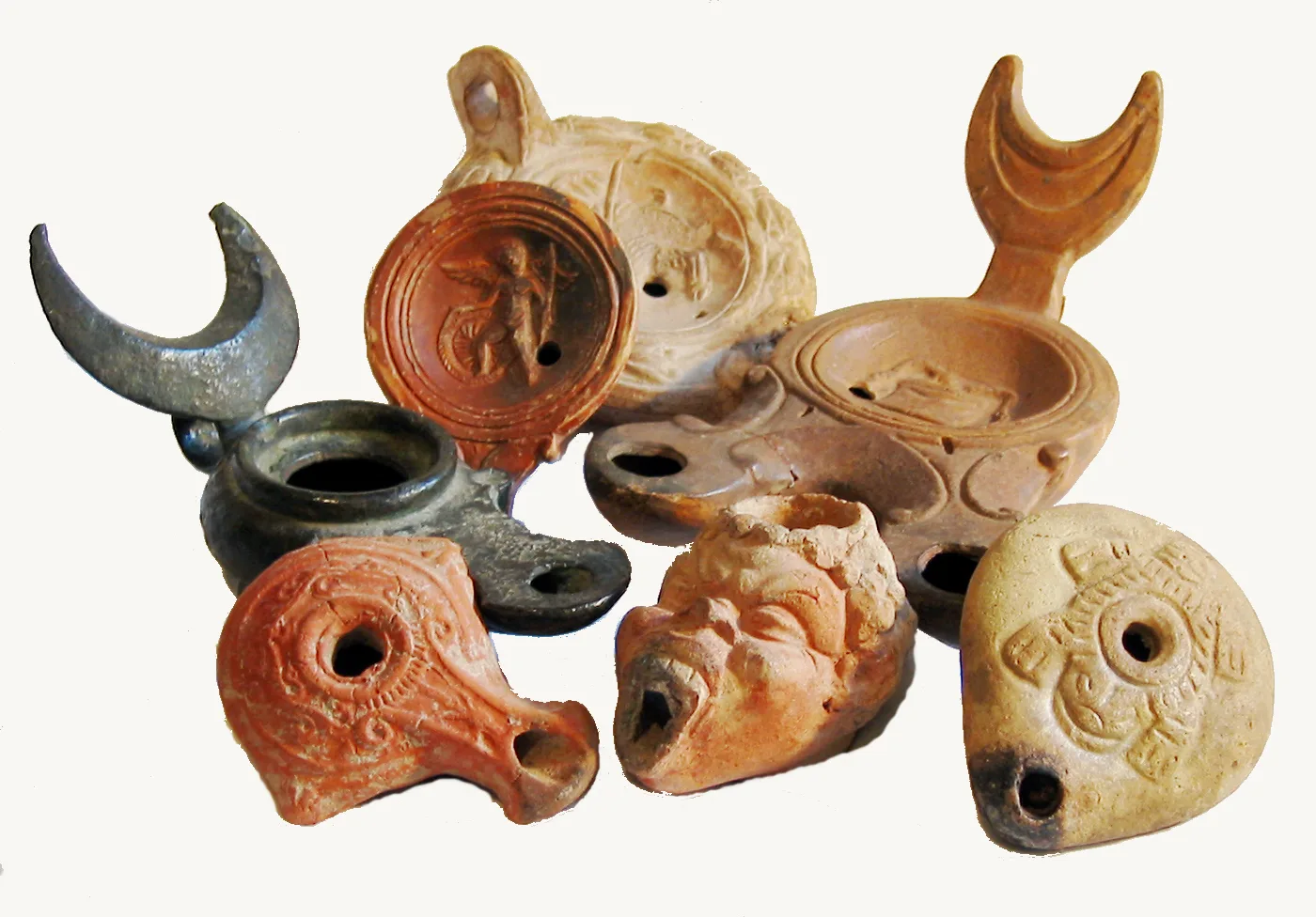
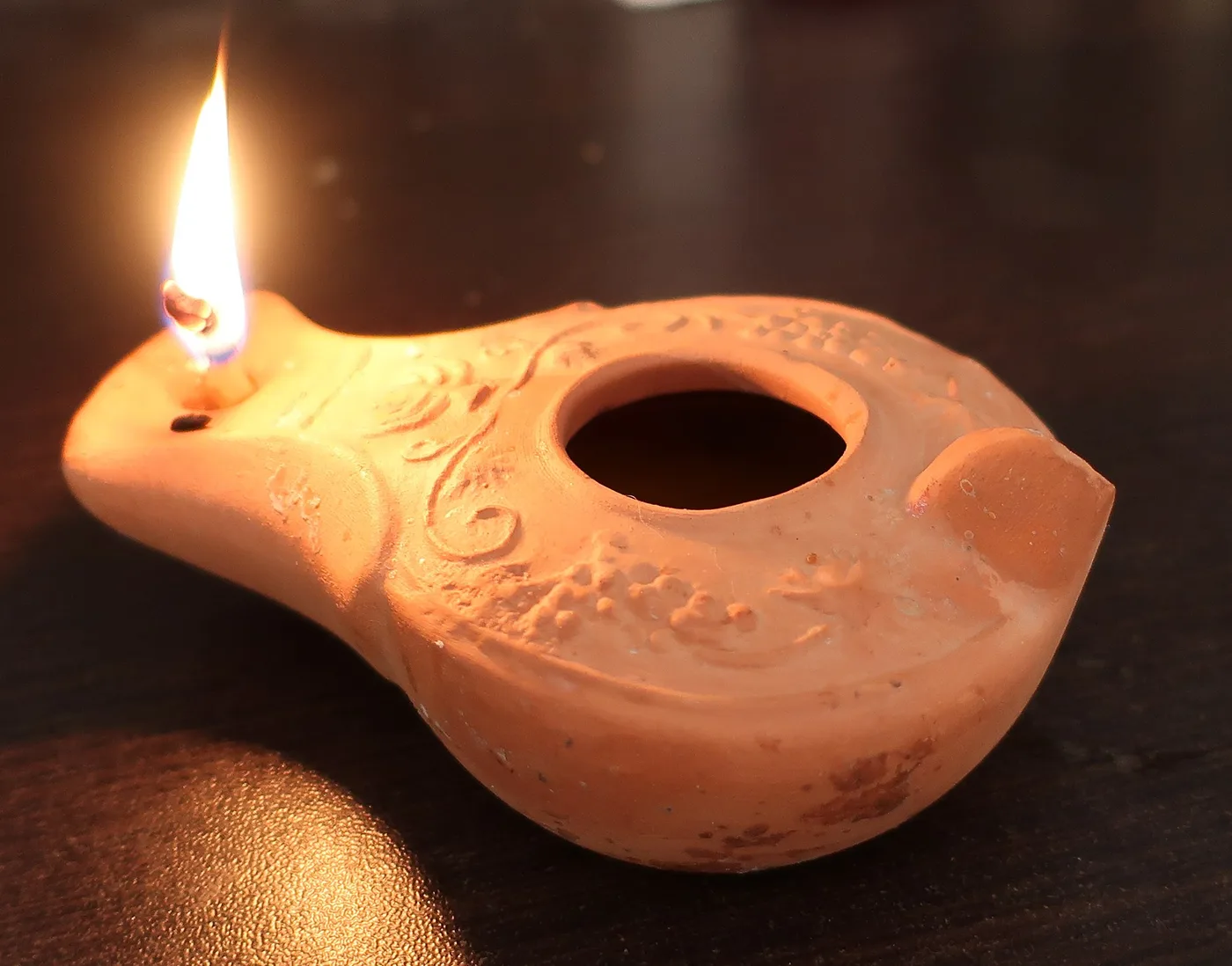
The oil lamp produced light by burning a wick saturated with oil contained in a relatively small vessel. The vessel was oblong, usually made of clay. While lamps could vary in size, an average home oil lamp measured about 13 by 8 by 4 centimeters (5 by 3 by 1.5 inches). It could take several forms. One form was simply a shallow dish filled with oil with a wick floating in it. Another kind of lamp was about the same size but closed, making it easier to carry without spilling the oil. In its top were two holes, a smaller one into which the wick was inserted, and a larger one for refilling the oil. The wick was usually made of linen.
Usage
Translation
In some languages the closest equivalent for “oil lamp” is “kerosene lamp.” Translators should avoid an expression that suggests a flashlight or any sort of electric light, which would be highly anachronistic. It is possible to say “lantern” or “light.” Another good cultural equivalent could be the candle, which works on the same principle as the oil lamp, only with solid fuel rather than oil. Candles were known in the ancient world, although they are not mentioned in the Bible.
As an object whose purpose is to give light, the lamp is sometimes used figuratively in Scripture. All the occurrences of the Hebrew word nir and the Greek word lucerna are figurative. The Hebrew word ner is used figuratively of Israel’s king (2SA 21:17), God or some something about him, such as his protection, guidance, blessing or word (2SA 22:29; JOB 21:17; PSA 18:29; PSA 119:105; PRO 6:23), life or death as the extinguishing of life (JOB 18:6; JOB 21:17; PSA 132:17; PRO 13:9; PRO 20:20; PRO 24:20), the spirit of man (PRO 20:27), peace or normalcy (JER 25:10), and thoroughness (ZEP 1:12). The Greek word luchnos is figurative of a person’s enlightenment (MAT 6:22; LUK 11:34, LUK 11:36), preparedness (LUK 12:35), prophetic voice (JHN 5:35), and a person’s face (SIR 26:17).
“Lamp” is often used metaphorically for a person’s life; for example, at JOB 21:17 (RSV “How often is it that the lamp of the wicked is put out?”) A Handbook on The Book of Job (page 398) points out that this line speaks of premature or unexpected death.
In several places the light-giving element of the lamp becomes a metaphor for God’s direction, usually supplied by his word, as a person walks through life. An example is PSA 119:105, which NIV renders “Your word is a lamp to my feet and a light for my path.”
While translators will usually agree that a particular passage is figurative, they may not always agree concerning the exact nature of the figure; for example, GNT and GECL do not agree about the meaning of the lamp imagery in JOB 29:3. This line is literally “when his lamp shone upon my head” (RSV). GNT says “God was always with me then,” while GECL has “He gave me success every day.”
For JER 25:10 see the comments at Millstones, mill.
When translating the Hebrew word pishtah in ISA 42:3, more formal translations use the literal rendering “wick”; for example, for the whole line RSV has “and a dimly burning wick he will not quench.” Common-language translations usually avoid such a word-for-word rendering that will not be commonly understood. Several good examples are GNT “He will not … put out a flickering lamp,” CEV “He won’t … put out a dying flame,” and NCV “He will not … put out even a weak flame.” Where a translator prefers to retain the image of the wick, it may be rendered “small strip of cloth.”