Discussion
A book on Bible plants would not be complete without some reference to the famous “burning bush” from which God revealed his sacred name to Moses in the Sinai Desert. It seems that the less evidence we have for something, the more vigorous is the debate! The most touted guess is that it is the Bramble Rubus sanguineus. This is implausible, even though enthusiastically promoted by the staff of the St. Catherine’s monastery at the foot of Mount Sinai, where a specimen of Rubus sanguineus has been planted. Apart from this individual plant, there is no evidence that any species of Rubus has ever grown in Sinai or even in southern Israel. The same is probably also true of Acacia nilotica, although that has been promoted by the botanists Moldenke and Tristram.
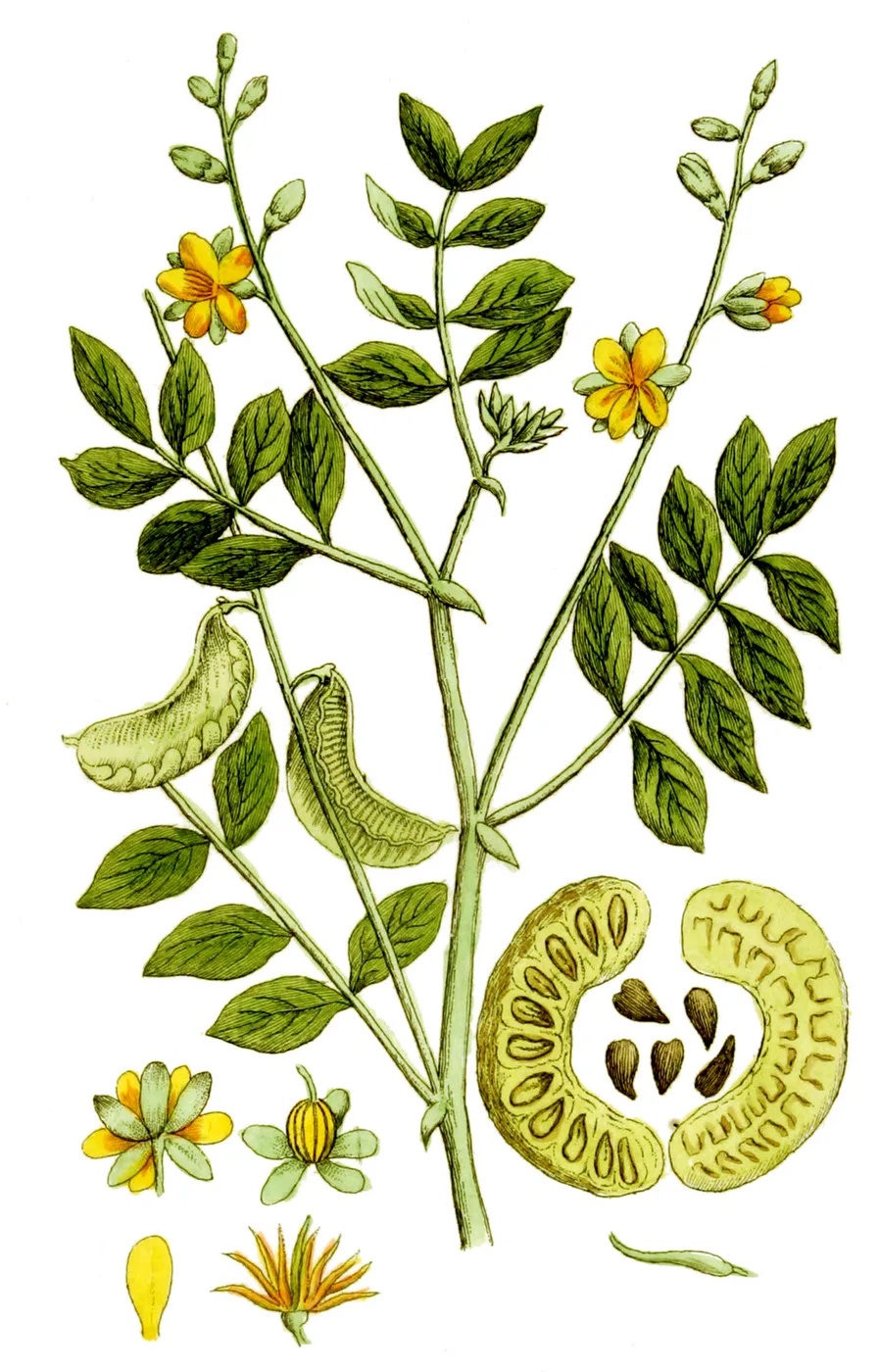
Zohary believes seneh to be Cassia senna, and argues strongly against the opinion that the “bush” is a species of Rubus. He also argues against the Acacia nilotica as a candidate because that has never grown in Sinai. Other possibilities are that the bush was a hawthorn (which has red fruits) or an acacia shrub that had a red-flowered parasite growing on it. Hepper states that it is impossible to tell. He says that the search for a single species is futile, and that the incident should be considered a manifestation of the “glory of the Lord” like that of 2CH 7:1, where “the dazzling light of the LORD ’s presence filled the Temple” (GNB). Among all the suggestions that have been made, four stand out as being botanically plausible, considering what sort of plants may have grown in the area of Mount Sinai at that time:
1. the Senna Bush Cassia senna (Arabic sene);
2. the hawthorn bush, which has red fruit that might suggest flames;
3. any acacia that might have had a red-colored parasite called Loranthus acaciae;
4. the plant Colutea istria, which grows on Mount Sinai and has bright yellow flowers suggesting flames.
Description
Translation
Note that all the furor described above is about what species seneh refers to. It is quite possible that it is a generic word like “shrub.” Unfortunately, many languages do not have a generic word for bush or shrub; they only have “tree” and “grass.” In West African English the word “bush” refers to an uninhabited wilderness area. Every year people “burn the bush,” and in a number of places translators have mistakenly used this concept in their translations of this passage and in DEU 33:16 where “him that dwelt in the bush” is particularly confusing to many West Africans. In the absence of a word for “shrub,” it may be necessary to use “tree.” To make the miraculous nature of the burning bush incident sensible, it may be useful to say “green tree” or “leafy tree.” The reference to seneh in DEU 33:16 appears to refer back to the incident in EXO 3:0 (though the New Revised Standard Version [NRSV ] renders seneh as “Sinai”), and the majority of translations make that connection explicit (for example, GNB, the New Living Translation [NLT ], the Revised English Bible [REB ], and the New Jewish Publication Society Version [NJPSV ]).