Discussion
As in the case of agarwood above (Agarwood (eaglewood, aloeswood, lignaloes)), Zohary is confident that the substance referred to by the Hebrew words qiddah and qetsi‘ah is oil or powder derived from the leaves, twigs, or bark of the Cassia Cinnamomum cassia, a tree found in East Asia. The name “cassia” may possibly come from the Khasi people of northeastern India and Bangladesh; earlier they lived in the area of Assam and Burma and were involved in the ancient cassia trade. So cassia oil may have been brought into Israel from East Asia. However, with respect to “cassia” and “cinnamon” in EXO 30:23; EXO 30:24, Hepper argues that these spices were probably not Asian spices as has often been supposed. Quoting research by Lucas and Harris on ancient Egyptian materials, he says that there is no evidence of these Asian spices in tombs in Egypt (Hepper, page 138). If they were being transported by the deprived Israelites, why were they not used by the more prosperous Egyptians? Further, how was Moses to have access to these substances in remote Sinai? Hepper favors southern Arabia and northeastern Africa as sources for fragrant barks and resins. Note the caravans of Tema and Dedan (JOB 6:19; ISA 21:13; ISA 21:14) and the visit of the Queen of Sheba (1KI 10:2).
Description
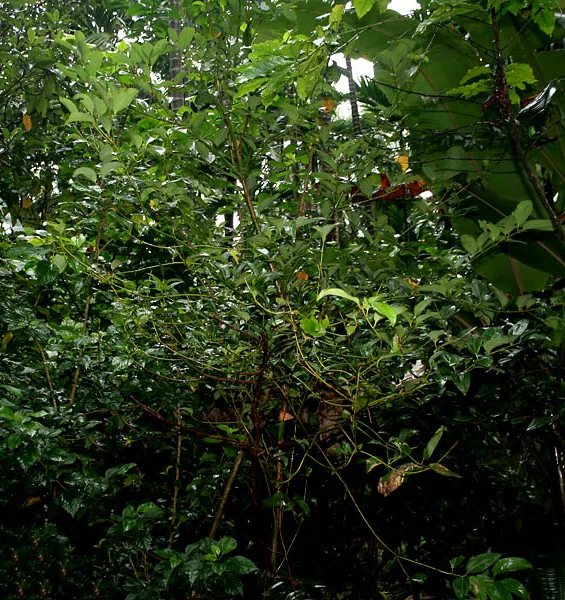
Asian cassia trees grow to 10 meters (33 feet) tall. They have distinctive opposite leaves with three lighter-colored veins or ribs radiating from the base. Their rather small flowers droop in bunches.
Special significance
Translation
Cassia is closely related to the well-known spice, cinnamon. In fact, much of the “cinnamon” sold in North America is cassia. Europeans and South Americans tend to use the real cinnamon from Sri Lanka and elsewhere. Since cassia is native to East Asia, translators there will know it by a local name, for example, kayu manis cina (Indonesian), kaeseo (Korean), ob choey chin / thephatharo (Thai), and que don / que quang (Vietnamese). Chinese has at least ten names for it, including guan gui and gui xin. It is cultivated there for its bark, buds, and oil. Since the passages that refer to cassia are non-rhetorical, translators elsewhere may transliterate this term from a major language (for example, Arabic darsini, kirfa, karfa, salika; French kas, kanéfis, kaneldechin /selon; Spanish/Portuguese cassia, canela de la China). Cassia is of the genus Cinnamomum, which is completely different from the genus Cassia of which there are many species in Africa. So transliterations based on “cassia” are potentially misleading in Africa. To avoid a wrong association with African cassia (which is not aromatic), African translators could do one of the following:
1. transliterate from the Hebrew qiddah;
2. transliterate from English (kasiya) and write a footnote saying this tree has no relationship to the cassia tree of Africa;
3. substitute a well-known sweet-smelling gum.