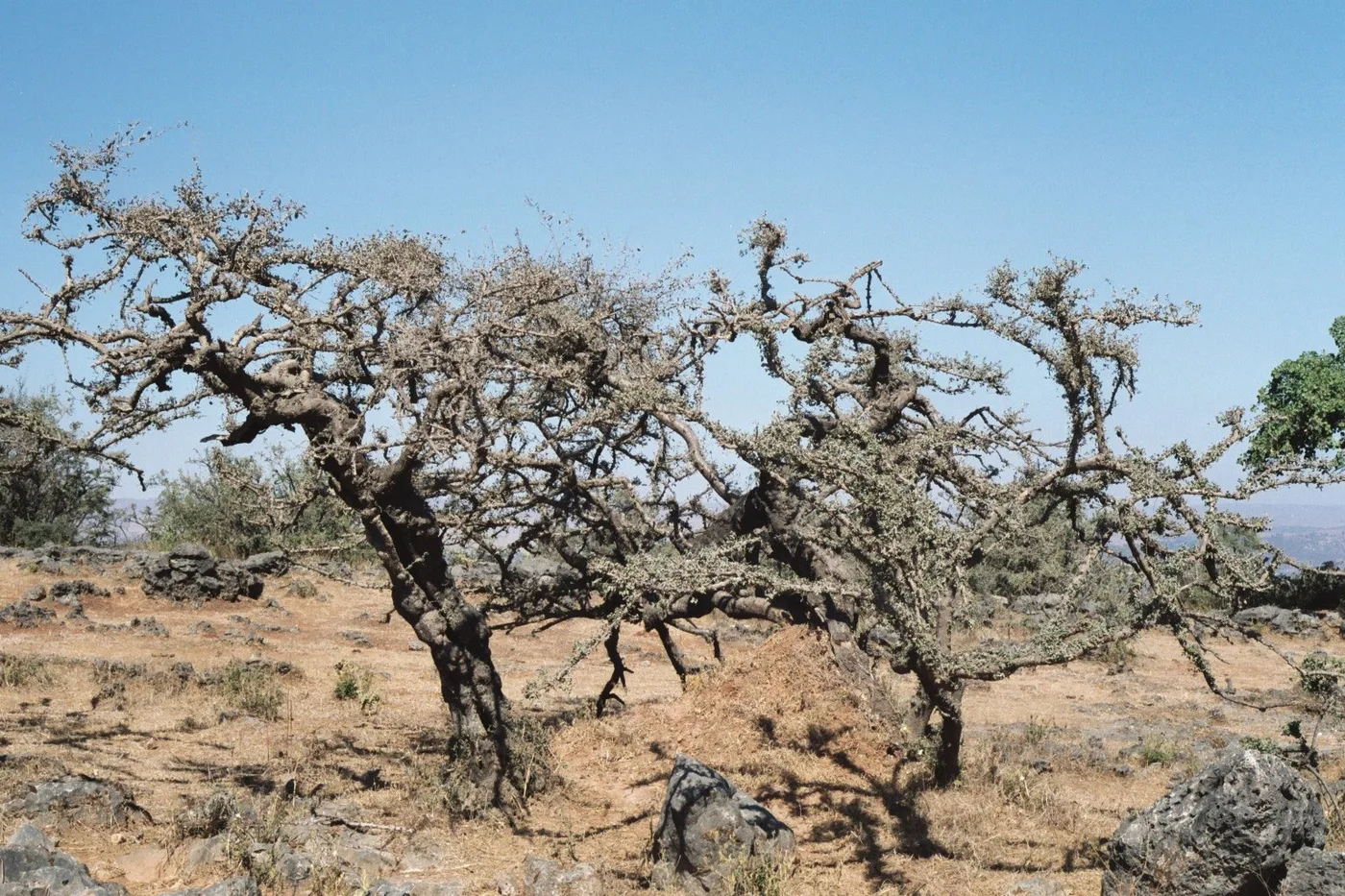
Discussion
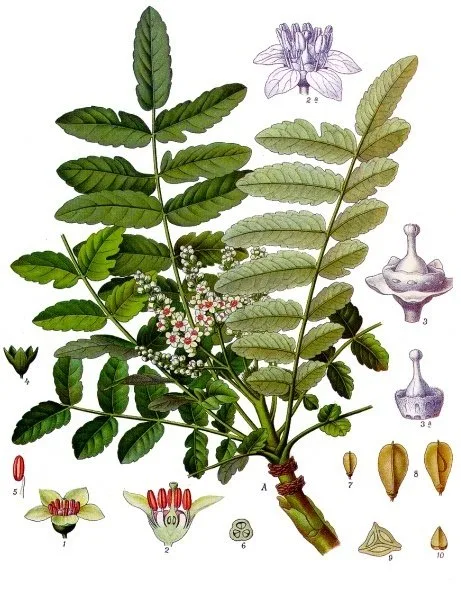
Today the best frankincense is reputed to come from Oman, but Yemen and Somalia also produce a lot of it. The name olibanum may come from the Arabic al-lubán (milk) or from the equivalent of “oil of Lebanon.” The Hebrew word levonah can mean either “white” or “Lebanese.”
Description
Boswellia trees are actually shrubs reaching 3 meters (10 feet) in height, with multiple trunks coming from the ground. They have pinnate leaves and small greenish or white flowers. The gum of Boswellia trees comes out by itself in little drops from the branches and twigs, but it can also be extracted by cutting through the bark of the trunk. The resin appears in globs and hardens.
Special significance
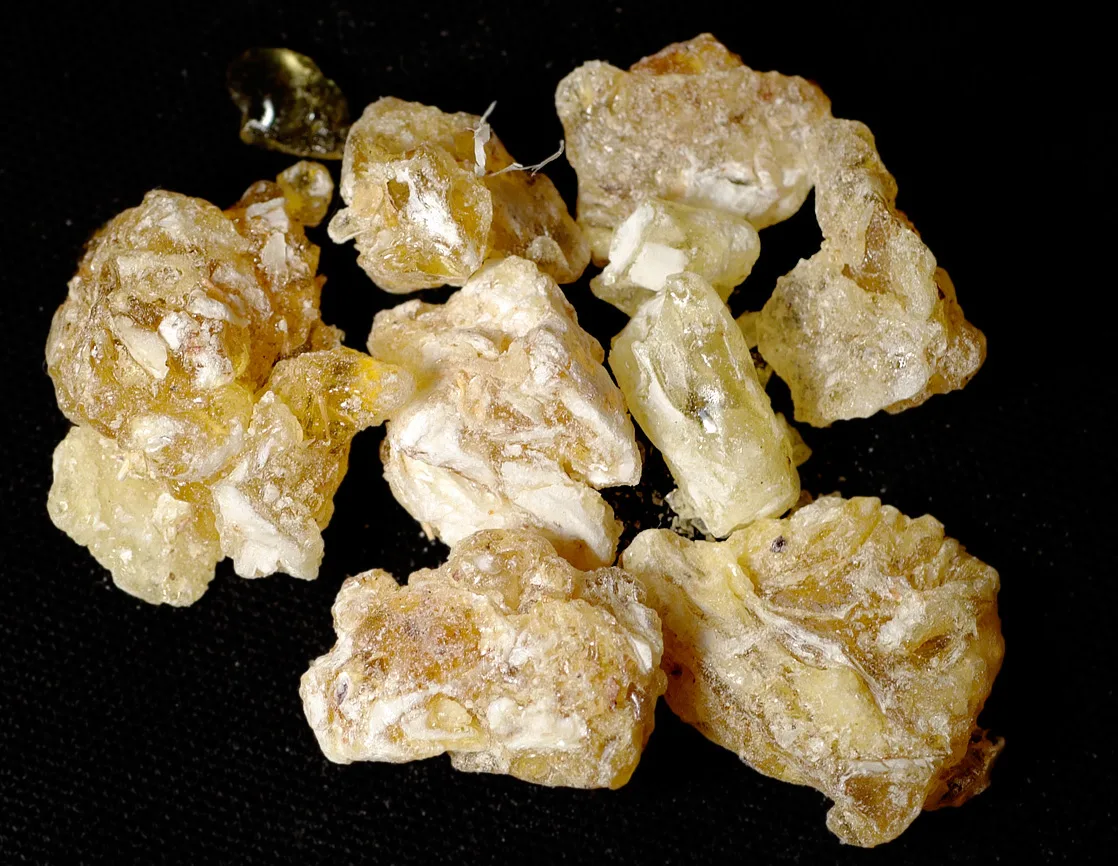
Translation
A classifier will be useful if available (for example, “resin of”). Transliterations of the word for frankincense from Hebrew (labona, lebonahi), Greek (libano), French (bosweli, olibán), or Arabic (akor, mager, mogar) will be more readable than those from English (firankinsensi).
In JER 6:20 God says, “To what purpose does frankincense [levonah ] come to me from Sheba, or sweet cane [qaneh hattov ] from a distant land?” In this passage two plant derivatives (levonah and qaneh hattov) are used in rhetorical questions that both refer to incense. The rhetorical questions can be converted to positive statements by saying:
It is useless for you to bring your levonah from Sheba.
Forget about your qaneh hattov from faraway lands.
In a freer translation one could take both plant substances as references to “incense” or “incense stuff.” A possible model that does this is:
You bring your incense all the way from Sheba, but why?
Why bother with sacrifice-stuff from faraway countries?
The last half of the verse helps to explain the meaning of the first half, and it would not be out of place to reverse the two halves if that would make the meaning more apparent.