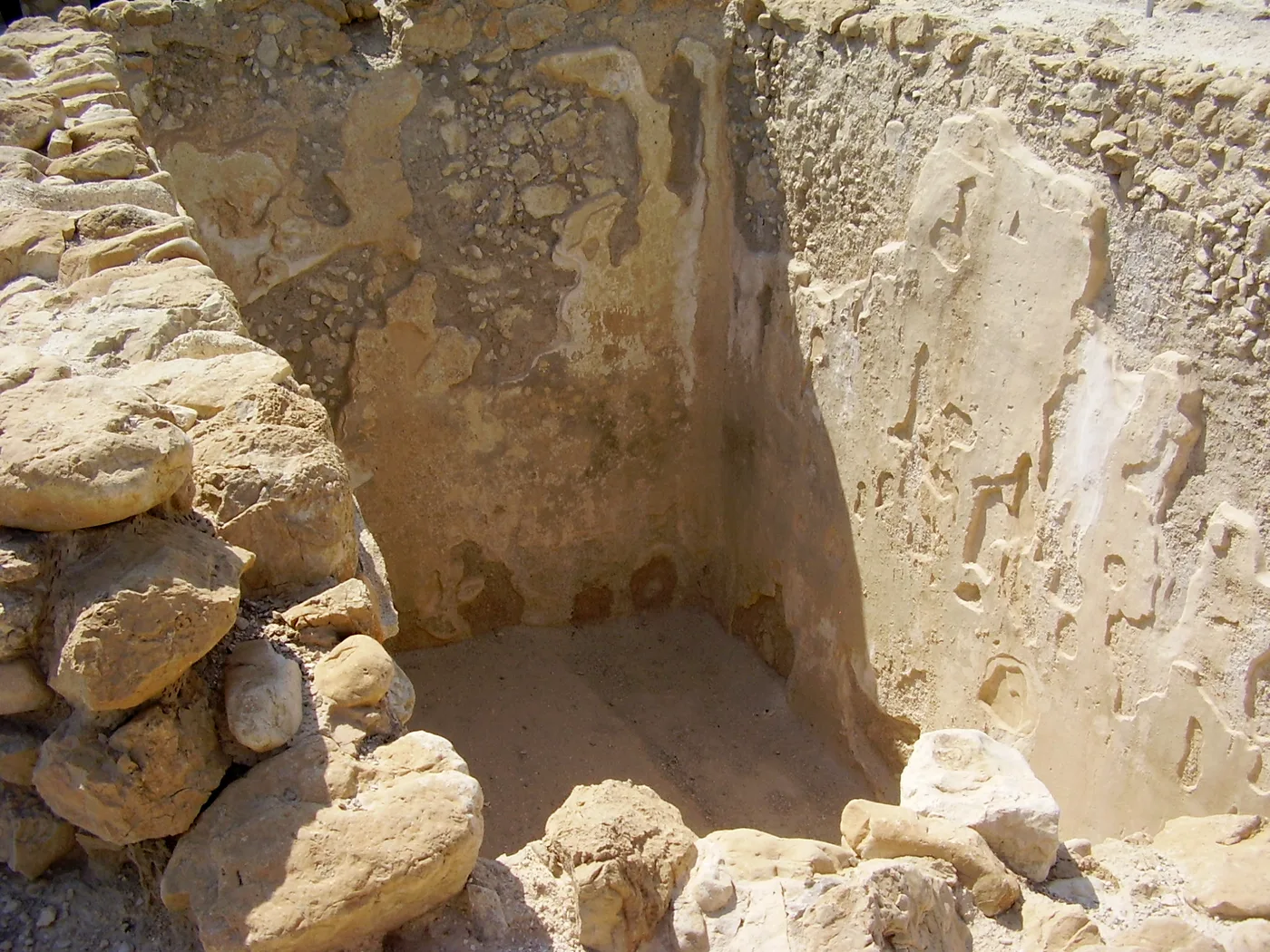
Description
The cistern was a pit hollowed out of solid rock for the purpose of storing water. Cisterns could be 6 meters (20 feet) across and 6 meters (20 feet) deep or even larger. In earliest times they were hewn out of rock that did not allow water to seep through it. With the discovery how to make plaster, cisterns could be dug in many kinds of rock and then lined with plaster, which sealed any holes or cracks.
Usage
In the land of Israel, almost all of the annual rain falls between the months of November and March. Cisterns served to store excess rainwater or water from springs that dried up in the summer. The stored water could be used during the dry months of the year.
Translation
A cistern differed from a well in that a cistern received water that flowed to it from a source removed from it at some distance, while the water in a well accumulated from its immediate vicinity. It is not always clear from the context whether a well or a cistern is intended in the passages listed above; for example, in NEH 9:25NIV, TOB and NCV have “wells,” while RSV, GNT and CEV have “cisterns.” Similar uncertainty exists for most of the above references to the Hebrew word bor. In some cases bor can refer to a “pit” that occurs naturally. This may be true of the bor into which Joseph was thrown by his brothers in GEN 37:0. Some translations have “cistern” (NIV, FRCL, GECL), some say “well” (GNT, CEV), while others are noncommittal with “pit” (RSV, NASB).
It is possible to render “cistern” with a descriptive phrase such as “hollowed place in a rock for storing water.” In 2CH 26:10CEV provides a helpful model for the clause “he dug cisterns” by expanding it as follows: “he had cisterns dug there to catch the rainwater.” In JER 2:13CEV says “you’ve tried to collect water in cracked and leaking pits dug in the ground.”
PRO 5:15: See the comments on this verse at Well.
ECC 12:6: For the last clause in this verse, RSV has “the wheel broken at the cistern.” This rendering is uncertain and translations differ. At the end of this verse the Hebrew text has two parallel clauses, which are literally “the jar will be shattered at the spring, and the wheel will be broken at the cistern.” Most translators and commentators understand the Hebrew word galgal (“wheel”) to refer to a kind of pulley that aided in lifting the water container at a well; for example, for the last clause CEV has “the pulley at the well is shattered” (similarly NJB, NAB, ITCL). Scott points out that the parallelism demands that galgal correspond to kad, which is a clay pitcher or jar. However, in his own translation he has “the water wheel broken at the cistern” (page 254). GNT seems to reverse the last two clauses in order to follow the order of events: “the rope at the well will break, and the water jar will be shattered.” It is probably best to treat the “wheel” as a pulley. Where a pulley wheel is unknown, translators may follow the GNT model. However, even if you follow GNT, a note may be necessary to explain that the rope was used to pull up a water container attached to it.