Description and usage
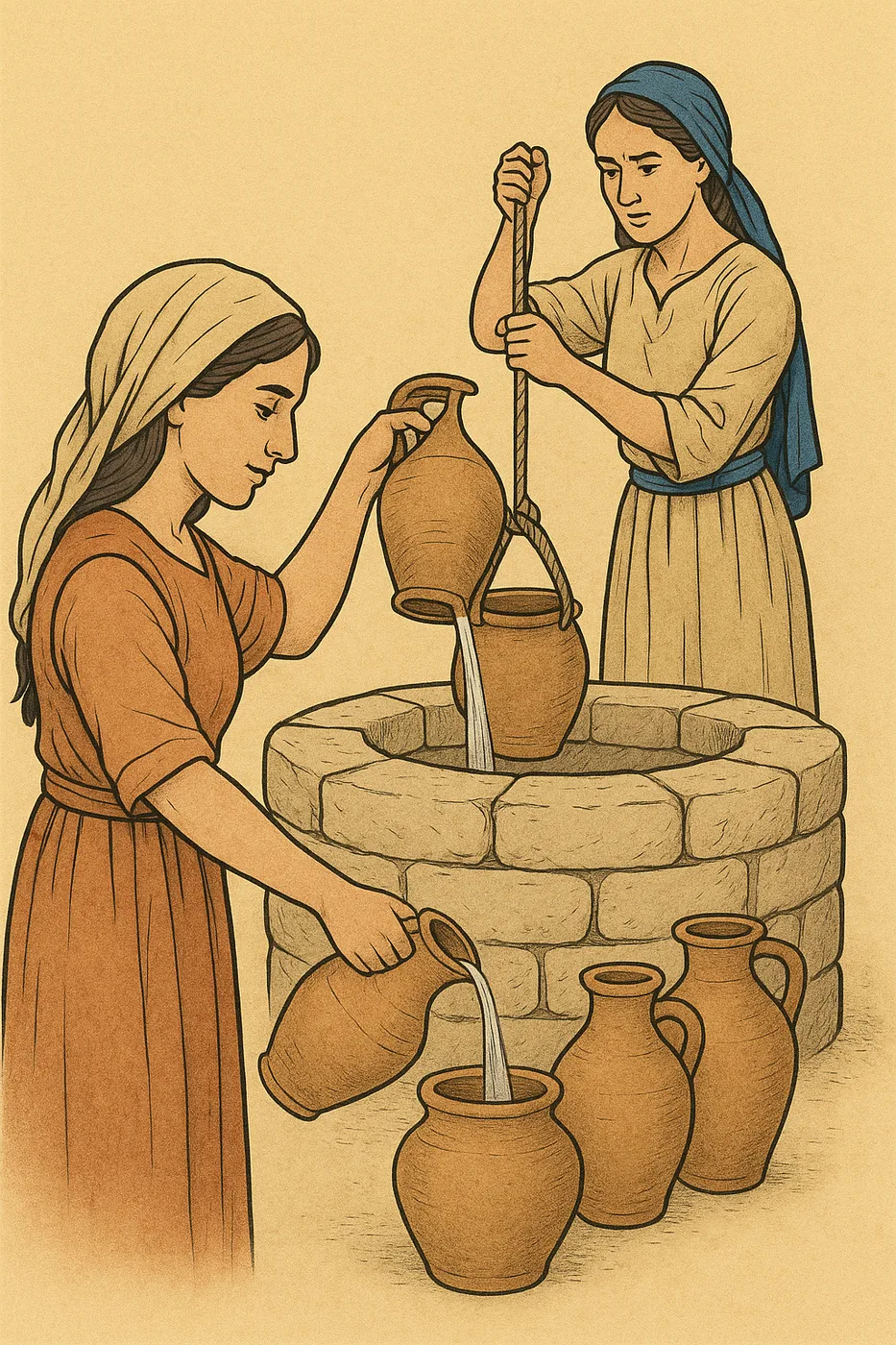
The well was a deep construction, often walled with stone, at the bottom of which was a pool of water. Wells were dug as deep as was necessary to reach usable water, sometimes more than 50 meters (165 feet) deep. For the difference between a well and a cistern, see Cistern.
Translation
Wells varied widely in construction, depending on the topography. In some cases a “well” was little more than a walled-in spring, and in fact the Greek word pēgē may indicate either a well or a spring, although most often it indicates a natural water source rather than a man-made one. In JHN 4:0pēgē is used interchangeably with frear, a word that refers to something dug or carved from rock. At JHN 4:14 most translations render pēgē as “spring,” although KJV and NASB have “well.” Most translations render pēgē as “well” in verse 6 and as “spring” in verse 14. A Handbook on The Gospel of John (page 111) offers a suggestion of how both are possible in a single context.
The Hebrew words given above all indicate holes that have been dug. Hebrew uses separate words for natural springs, which, of course, were not made by people. Because the Greek word frear indicates a hole that has been dug or carved out, it is not always possible to tell whether it indicates a cistern or a well.
PRO 5:15: The context of this verse indicates that the words “well” and “cistern” are used figuratively of a man’s wife. So GNT translates “Be faithful to your own wife and give your love to her alone.” CEV preserves the imagery by saying “You should be faithful to your wife, just as you take water from your own well” (similarly NCV). Compare also FRCL: “Your wife is like a spring of pure water. Drink from that source!” (similarly ITCL).
LUK 14:5: Any common term for “well,” “pond,” “fountain,” or “cistern” is acceptable here, provided that falling into it implies the danger of drowning.