Description and usage
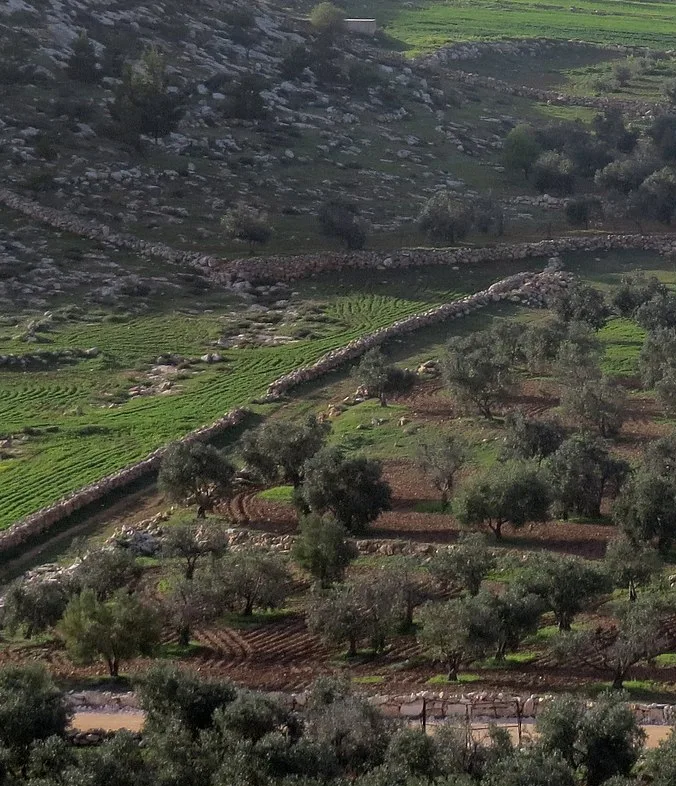
The fence was a structure for enclosing an area. Fences in the land of Israel were most often made of stone, less often (and only as a temporary structure) of sticks and brush.
Translation
In many societies there is some type of fence, wall, or barrier employed to surround fields. In some instances the fence may consist of piled up logs or sticks; in other instances it may be made of packed dirt or of laid-up stone. What is important, however, is not the form of the “fence,” but its function, and therefore translators may often use a descriptive expression, for example, “barrier to surround a field” or “barrier to keep animals out of the field.” Because stone was such a common material in the land of Israel, fences were usually made of loose stones. In many cultures such stone structures are called “walls,” not “fences.”
The Hebrew word gvul, which normally means “boundary” (see Boundary marker), is used in several places in Ezekiel with a somewhat different meaning. In EZK 40:12 it seems to refer to a “low wall” (GNT), “railing” (CEV), or simply “barrier[s]” (RSV, NJPSV). In EZK 43:13; EZK 43:17; EZK 43:20 the word describes a kind of “rim” (RSV, NIV) around the base and different levels of the altar.
Some languages distinguish between the outer wall of a building and the inner walls that separate rooms. The Hebrew word chomah normally indicates an outer wall, specifically of a city (see City wall, rampart, battlement). The references listed above are exceptional. The other Hebrew words can be used for both inner and outer walls, and the translator must decide the correct meaning from the context. The Greek word toichos refers to an inner wall. In translation the outer wall of a house may be called “side of a house,” and an inner wall may be referred to as “partition in a house.”
EZK 13:10: In this verse the Hebrew word chayits indicates a “divider,” a wall that is temporary and not very substantial. Translations attempt to indicate this by the addition of a modifier, such as “shaky” (CEV), “flimsy” (NIV, Living Bible [LB]), “weak” (NCV), “unstable” (SPCL), or “of loose stones” (GNT, GECL).
The Hebrew words shur and shurah have been understood in various ways. They literally mean “row.” This could mean a row of stones, so a wall or a fence. In GEN 49:22 most translations have “wall” (RSV, CEV, FRCL). However, in JOB 24:11RSV renders shurah as “olive rows.” As pointed out by A Handbook on The Book of Job, this not likely to be the meaning of the text. Olive trees in the Middle East are very often grown on specially prepared terraces. The terraces themselves are supported by retaining walls, which could be the meaning of shurah here. NRSV has abandoned the RSV rendering with “terraces” (also NIV). GECL says “garden,” and NASB has “walls.” GNT and CEV choose not to translate the word.
In EPH 2:14 the Greek words mesotoichon and fragmos are used figuratively of the Law, which constituted a barrier between Jews and Gentiles, “the wall of separation” (RSV). Here these words may be rendered “the wall to keep apart” or “the wall to divide.”