Reference:”
Discussion
The Mosaic instructions for celebrating the Festival of Shelters mentioned in LEV 23:40 include the Hebrew words ‘ets hadar, often translated as “goodly tree.” The word hadar, however, could be the name of a specific tree (note the similarity to “cedar” in English and cedro in Italian). Some botanists (Moldenke and Goor, for example) hold that the Citron Citrus medica (now called etrog in modern Hebrew) was introduced into the Middle East in ancient times. Excavations in Mesopotamia have revealed citron seeds going back to 4000 B.C., and a Jewish coin made in 136 B.C. shows a picture of the citron on one side. Some say that Nehemiah and others brought the tree to Israel from Babylonia on their return from exile. Nehemiah’s instructions for celebrating the Festival of Shelters (NEH 8:15) only mention going out “to the hills” to collect various branches for the construction. He doesn’t mention fruit. So probably ‘ets hadar is a generic phrase. No English version that I know of uses “citron” in Leviticus. NLT, however, uses “citrus trees” (with a footnote saying “or ‘majestic trees’”), and NJPSV transliterates, saying “hadar trees.” Many commentators, such as Keil and Delitzsch, believe that the phrase does not refer to a specific tree but is a generic expression introducing the others in the list. Both Zohary and Hepper likewise cast some doubt on the interpretation of hadar as citron, but both include it in their discussion as possible, in deference to Jewish tradition.
Description
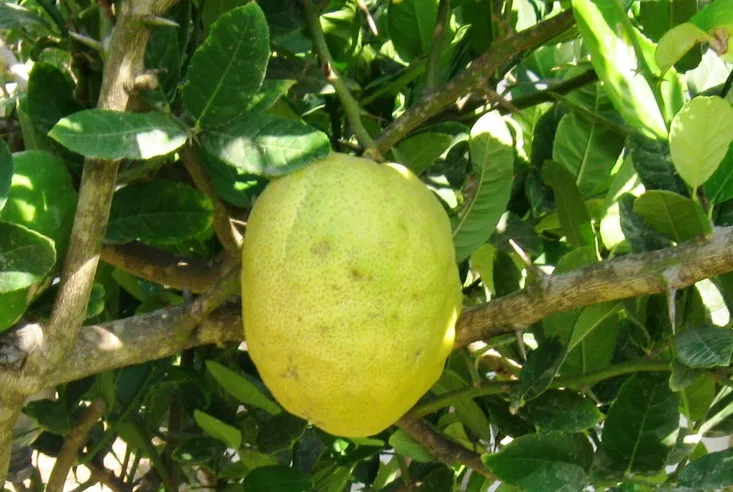
The citron tree is a type of citrus that grows naturally to about 4 meters (13 feet), with dark evergreen leaves, thorns, and fragrant white flowers. The fruit, like that of the lemon tree, is yellow and very sour. Citron trees are raised commercially in many parts of the world. The prepared peelings are (mostly) shipped to Europe and America to flavor cakes. In Japan and China people value the fragrant smell of the citron. An oil can be distilled from the peels and used in perfumes. Citron fruit was also used in ancient times to treat sicknesses, and it is used medicinally up to the present day in Southeast Asia and South America. Today Jews in Israel carefully prune citron trees to keep them only about 70 centimeters (2 feet) tall, and protect the fruits from any damage so that they are perfect for use in the Festival of Shelters.
Translation
If the translator decides that the Hebrew expression peri ‘ets hadar is a generic phrase in LEV 23:40, there is still a decision to make because of the structural ambiguity of the phrase in context: is it “the fruit of the good tree X” or “the good fruit of tree X?” GNB, CEV, NIV, NCV, and GW take hadar (“good”) to modify peri (“fruit”), whereas REB and NJPSV take hadar to modify ‘ets (“tree”).
For those who wish to follow the Jewish tradition and NLT, citron trees are known throughout the tropical world in many kinds, and many languages have borrowed a generic word for them, with modification for the particular species; for example, lemo or lemuno (English), cedrat (French), cidra or poncil (Spanish), cidrão (Portuguese), cedro /cedrone (Italian), cedratzitrone or cederappel (German), and citroen (Dutch). In India it may be called beg-poora; in China, kou-yuan; in Malaya, limau susu.