Discussion
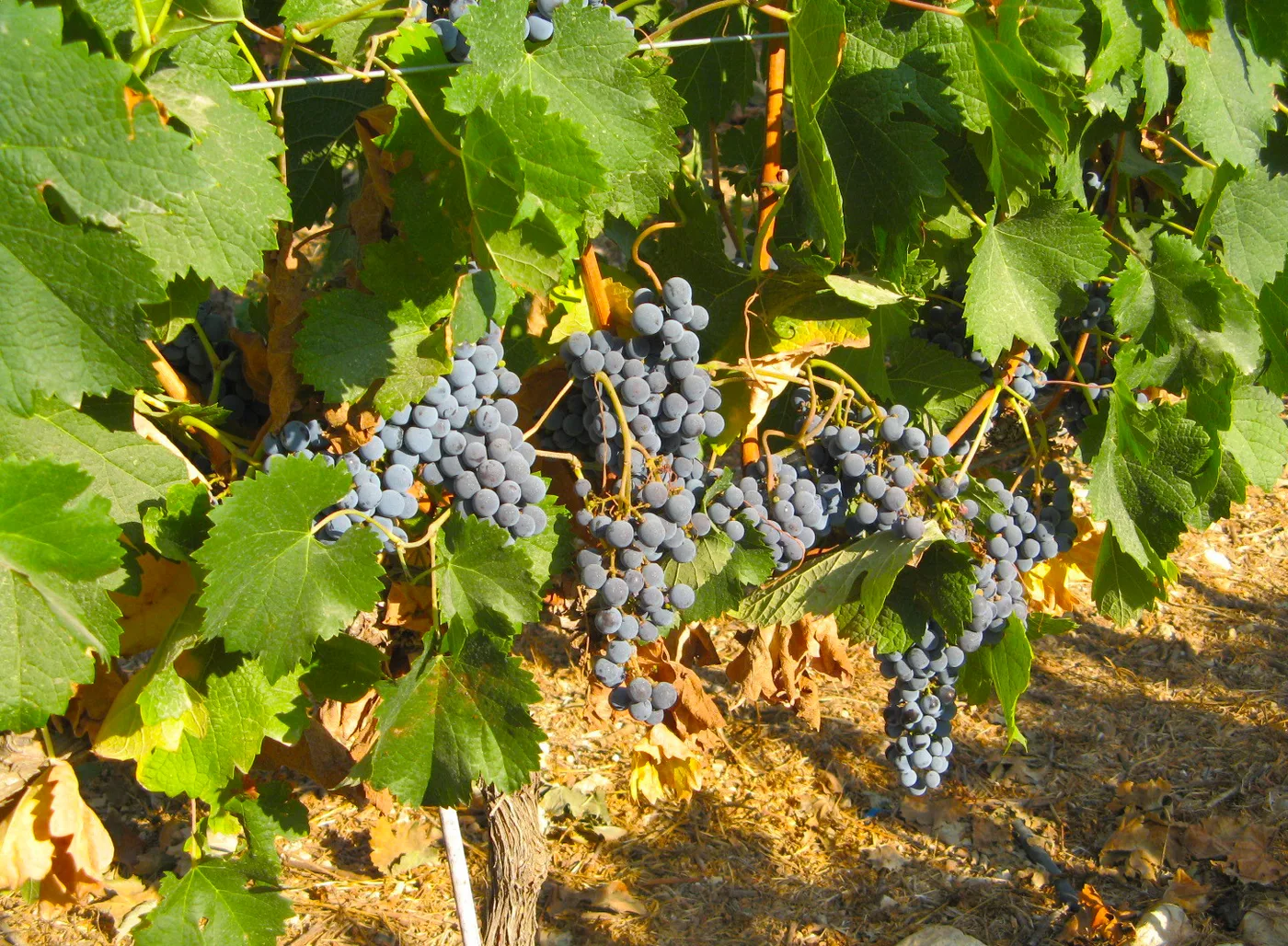
The Common Grape Vine Vitis vinifera is mentioned more often than any other plant or tree in the Bible.* Excavations in Greece have discovered grape seeds dating to 4500 B.C. Egyptian records document the existence of cultivated vines in Canaan as early as 2375 B.C., and subsequent records report trade in vine products around 1360 B.C. and many times thereafter.
Description
The vine is a creeping plant that develops a woody stem when it matures. It grows along the ground until it finds a tree or other object to climb, using tendrils. It bears bunches of small round fruit that are sweet and juicy. Today farmers grow them commercially throughout the Mediterranean area, in South Africa, in North America, and in many other countries. The first reference to the vine in the Bible (GEN 9:20) tells us that Noah planted a vineyard (Hebrew kerem) and that he made an alcoholic drink from the fruit. Farmers since then have improved on the size, color, and quality of the fruit by careful pruning and selection until now there are at least 65 kinds of grapevines. Like many other plants in temperate areas, the vine has leaves that appear in early spring. After the fruit is picked and the weather gets cold, the leaves drop off and the plant is bare until the following spring.
A typical vineyard in Bible times was surrounded by a stone fence. It had a stone tower from which the owner could watch for predators, and a place to squeeze the juice out of the fruits.
References to the vine and its fruits in the Bible are found in descriptions of farms, of sacrifices, and of social interaction.
Special significance
The Hebrew word shekar (“strong drink”) probably refers to a alcoholic drink made from grain, honey or dates, but could also have been distilled from wine.
Translation
Vine and vineyard: There are around 65 kinds of grapevines (Vitis vinifera) found in the Northern Hemisphere. They belong to a larger family of creeping plants called Vitaceae, which has over 800 species throughout the world including many in the tropical and warm climates of the world.
Grapevines have occasionally been grown in West Africa (for example, in The Gambia and in northern Nigeria) but are not well known even where they are grown commercially. Attempts at substituting a local tree name have not been entirely successful because the species chosen is usually not cultivated and/or does not have the same economic or social function that the grape had in Israel.
Thus it is probably best to use a transliteration from a major language. However, in parts of Nigeria and perhaps elsewhere, the word grep refers to “grapefruit” and should be avoided in translation. A transliteration from “vine” or “wine” is preferred, although a translator needs to be careful. The English word “vine” refers to any creeping plant, but it also refers to a particular kind of vine that produces grapes (Vitis vinifera). This can be confusing. Furthermore, translators in English-speaking countries should think carefully about what they are going to do with the word “wine.” In The Gambia, Mandinka translators first used “wayini tree” but later concluded that it may be better to have a word for “vine” that is not necessarily identical with “wine.” Bine, from binekaro (“vinegar”), was considered, as was inabi (“grape”) from Arabic.
Languages that borrow the Arabic word inabi must deal with the fact that this word bears an unfortunate resemblance to annabi (“prophet”) and new readers reading “water of inabi” in a context of prophecy may associate it, for better or worse, with prophets and prophecy. In northern Nigeria church people have gotten used to inabi in the New Testament even though many of them don’t know what it is. Rubassa in Nigeria uses a wild grape-like plant (afwafwa)**, and Igala has used the same species (achiwebetema) for years. Likewise, two translations in Mali and Burkina Faso use their local name for a wild vine (Lannea microcarpa) for the biblical vine. There is a species (Rhoicissus tridentata) in southern and eastern Africa known as “African grape” (locally called “bobbejaantou”). In such cases translators should write a footnote (or glossary item) stating that the grapes of Bible times were larger and sweeter than the local variety, and that they were cultivated extensively as a source for producing beverages. Other possibilities for transliteration are: vinyola /videra (Portuguese), vitis (Latin), and inab (Arabic).
Fruit of the vine (Hebrew ‘enav; Greek botrus, staphulē): There is some evidence that botrus refers to a bunch of grapes, while staphulē refers to individual grapes. According to Louw and Nida (Greek-English Lexicon of the New Testament based on Semantic Domains), however, both words may refer to individual grapes as well as bunches of grapes. The Hebrew word tirosh is equivalent to the word “vintage” in English, that is, the grape harvest and possibly the first squeezing of the grapes. It is normally used along with the words referring to the olive harvest (yitshar) and grain harvest (dagan).
Vineyard: The typical translation solution for translating “vineyard” is to take the word chosen for “vine” and expand to “field/farm of vine trees.”
Beverages made from vine fruit: Grape juice contains yeast organisms that make it ferment naturally, converting natural sugar into alcohol or vinegar within a day or two, depending on the weather (Hepper, page 101). In normal wine preparation, the juice (called “must”) is allowed to ferment for six weeks, after which the clear liquid is poured out into another container leaving behind the sediment (the “lees”; see JER 48:11) consisting of seeds, twigs, and skins. Once it is in sealed containers for storage it is called yayin in Hebrew. Translators from churches that require abstinence from alcohol are tempted to avoid or downplay the fact that yayin refers to an alcoholic drink. This is difficult to defend since the Jews had no refrigeration to keep yayin cool enough to prevent fermentation.
The Hebrew word tirosh, sometimes translated “new wine,” is problematical. There is no phrase “new wine” in the Hebrew Old Testament or the Septuagint translation of it. The Septuagint usually translated tirosh simply as wine (oinos in Greek). In the New Testament Jesus creates the phrase “new wine” for his parable of the wineskins, linking it with new wineskins (MAT 9:17; MRK 2:22; LUK 5:37; LUK 5:38); it seems to be a made-up phrase there, not a technical expression. In NUM 6:3; NUM 6:4 the Nazirites were prohibited from drinking wine, strong drink, and vinegar, or even eating grapes or grapeskins, but tirosh is not mentioned there, suggesting that it may have even been an abstract term like the English word “vintage,” which refers to the grape harvest. The word tirosh is usually used with the Hebrew words for unprocessed grain (dagan) and olive oil (yitshar), in contexts that refer to the produce of the land. What RSV calls “new wine” in these passages is better rendered “vintage” in English. In ISA 24:7 tirosh seems to refer to the grapevines themselves (so GNB, CEV, NLT). In MIC 6:15 it refers to grapes. In JOL 2:24 it seems to refer to freshly squeezed grape juice. It occurs only twice with the Hebrew verb for “drink” (ISA 62:8; MIC 6:15), but in both those passages it can be taken as metonymic, not literal.
Some have tried to argue that tirosh was unfermented grape juice, which may be true in JOL 2:24, but that is rather beside the point since it does not refer to a beverage in most cases. Even if tirosh is assumed to include the juice in its first stages on the first day after squeezing, it would have been mildly alcoholic since it has a kind of yeast in it and the Jews had no means of refrigeration. A case in point is HOS 4:11, which says “Yayin and tirosh take away understanding.” Why? Surely because they contain alcohol! Another example is JDG 9:13, where the grapevine in the Parable of the Trees says, “Shall I give up my tirosh that cheers gods and men?” I take tirosh here as a metonym for the final product. But if it is literal, why would it cheer anyone, if not because of its alcoholic content?
Sometimes translators, even if they concede the above, prefer to use a literal expression like “wayin” precisely because it is not well known, and thus hides the problem. This is not very satisfactory. They need to know that there are possibilities for translating these words contextually. For example, in passages where tirosh refers to a product of the land along with grain and oil, a phrase like “the juice of vayin fruit” is an acceptable translation of tirosh. In places where the reference is to drunkenness, the local word for alcoholic drink may be appropriate, and in fact, need not cause any offense. The compulsion to be concordant with English “wine” is what causes the problem.
On the other hand there are communities where yayin, tirosh, and the Greek word oinos have been translated using a word for a locally popular alcoholic brew, such as guinea corn (sorghum) beer. This, however, is not technically accurate. Properly speaking, wine is made from fruit, and beer from grain.
There are a few other Hebrew words that may refer to wine (for example chemer, sove’, mezeg; see WTH, Wine) but they may be generic, or abstract, or poetic, or they refer to a drink made from fruit other than the fruit of the vine, such as pomegranates or dates, so we do not consider them here. In a number of places, wine is referred to indirectly. When a drink offering of wine was required, as in DEU 15:14, the people are told to bring the offering “out of your wine press [yeqev in Hebrew].”
NUM 28:7: RSV renders the Hebrew word shekar in this verse as “strong drink.” NIV and NJB take it literally here, saying “fermented drink/liquor.” NLT is similar with “alcoholic drink.” GNB, CEV, and others just use “wine.” (REB cleverly does both by rendering this verse as “The wine for the proper drink-offering is to be a quarter of a hin to each ram; you are to pour out this strong drink … .”) Some commentators see this as a strange use of shekar, which normally refers to alcoholic drinks made from grain or honey. They think “wine” was intended and that a late editor used shekar possibly under the influence of Akkadians, who always talked about using shikar for any kind of libation. See WTH, pages 374–375, for further discussion.