Discussion
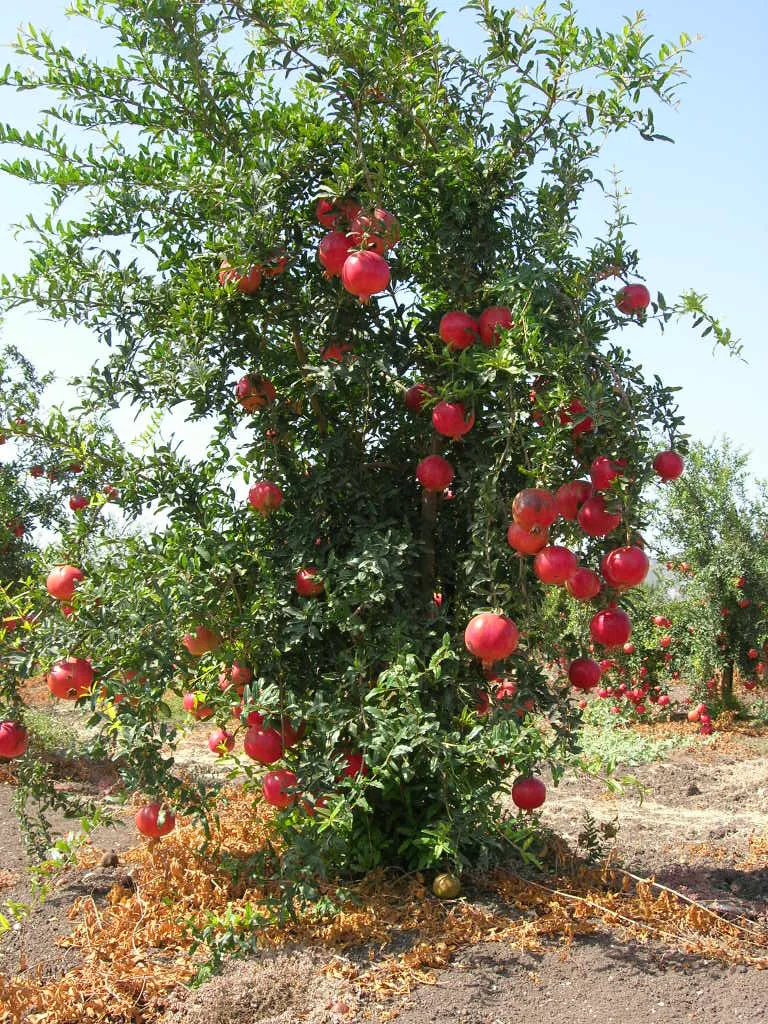
The Pomegranate Punica granatum has been grown from ancient times across the Middle East over to Iran and into northern India. It is widely cultivated throughout India and the drier parts of Southeast Asia, Malaya, the East Indies, and tropical Africa. Pomegranates are now found throughout the warm parts of southern Europe and across North Africa and Asia all the way to Nepal. Images of pomegranate fruits have been found in Pharaoh’s temple in Karnak, Egypt, dating from around 1480 B.C. In classical Latin the species name was malum punium (apple of Puni) or malum granatum (seedy apple). This has influenced the common name for pomegranate in many languages (for example, German Granatapfel, “seeded apple”). The English word “pomegranate” itself comes from Latin pomum (fruit, apple) via Old French; (compare pomme in French). The Arabic rummân passed into some other languages, including Portuguese romã.
Description
Special significance
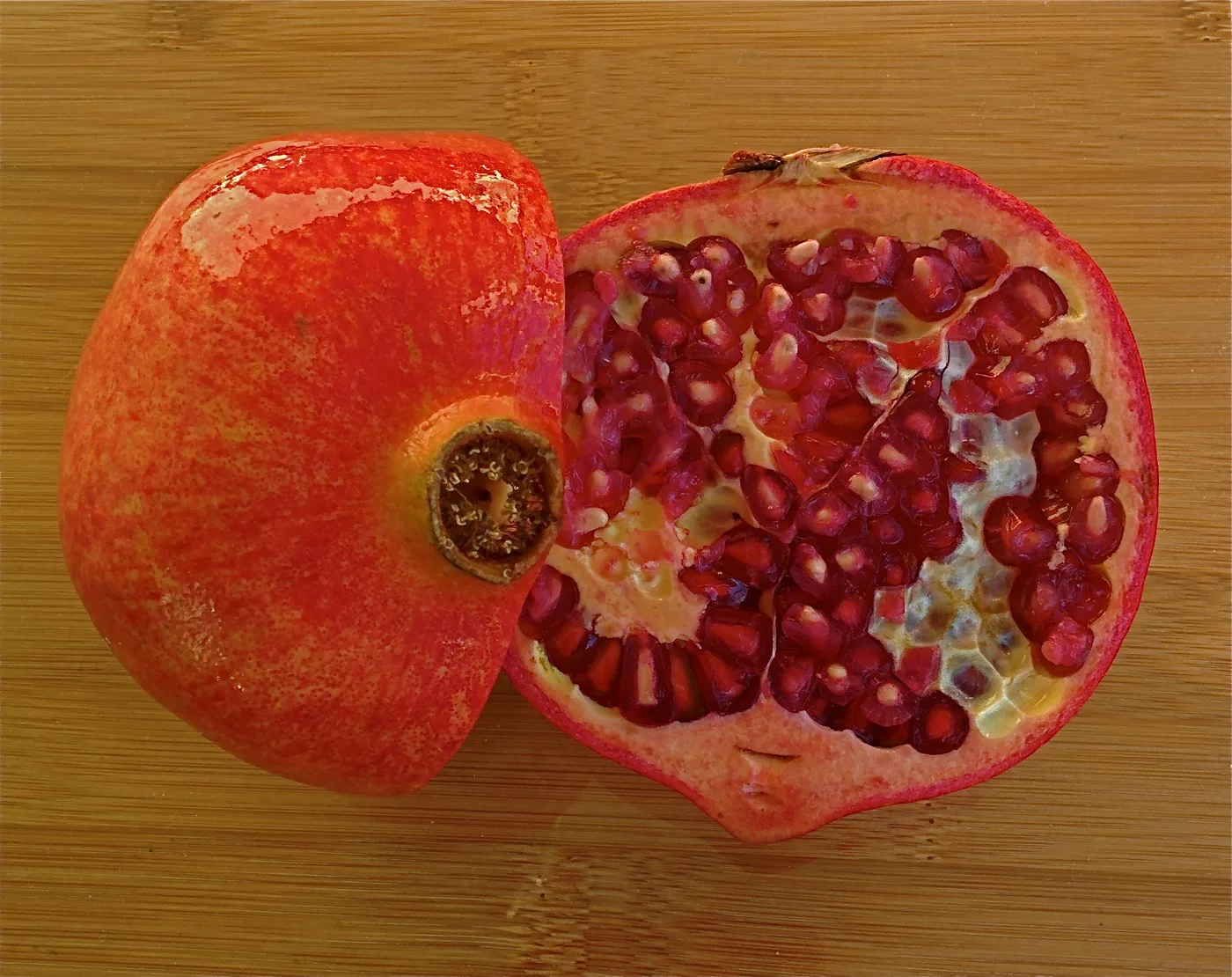
The pomegranate was one of the seven “special” foods mentioned in DEU 8:8 that the Israelites would find in Canaan. The fruit was one of several brought back to the camp of the Israelites by the men who scouted out Canaan (NUM 13:23). In JOS 15:32 it is a place name. In SNG 4:3 the bride of the king is said to have cheeks like halves of a pomegranate, a reference, probably, to their red color. The flower-shaped end of the pomegranate fruit made it an attractive decoration, for example on the fringe of the priests’ robes (EXO 28:33; EXO 28:34; EXO 28:34) and on the columns and furniture of the Temple (2KI 25:17). One of the earliest artifacts we have of the Temple in Jerusalem is a pomegranate-shaped carving considered to be the head of a staff. The prophet Joel mentions the pomegranate as one of five species that were dying because of a drought and a locust plague (JOL 1:12).
In Jewish tradition the pomegranate stands for righteousness, because it is said to have 613 seeds, corresponding to the 613 commands of the Torah. For this reason and others many Jews eat pomegranates on the Jewish New Year Festival (Rosh Hashanah). Jewish tradition also holds that the pointed calyx of the pomegranate is the original “design” for a royal crown.
The Babylonians believed chewing pomegranate seeds before battle made them invincible. The Qur’an mentions pomegranates three times, twice as examples of the good things God creates, once as a fruit found in the Garden of Paradise.
Translation
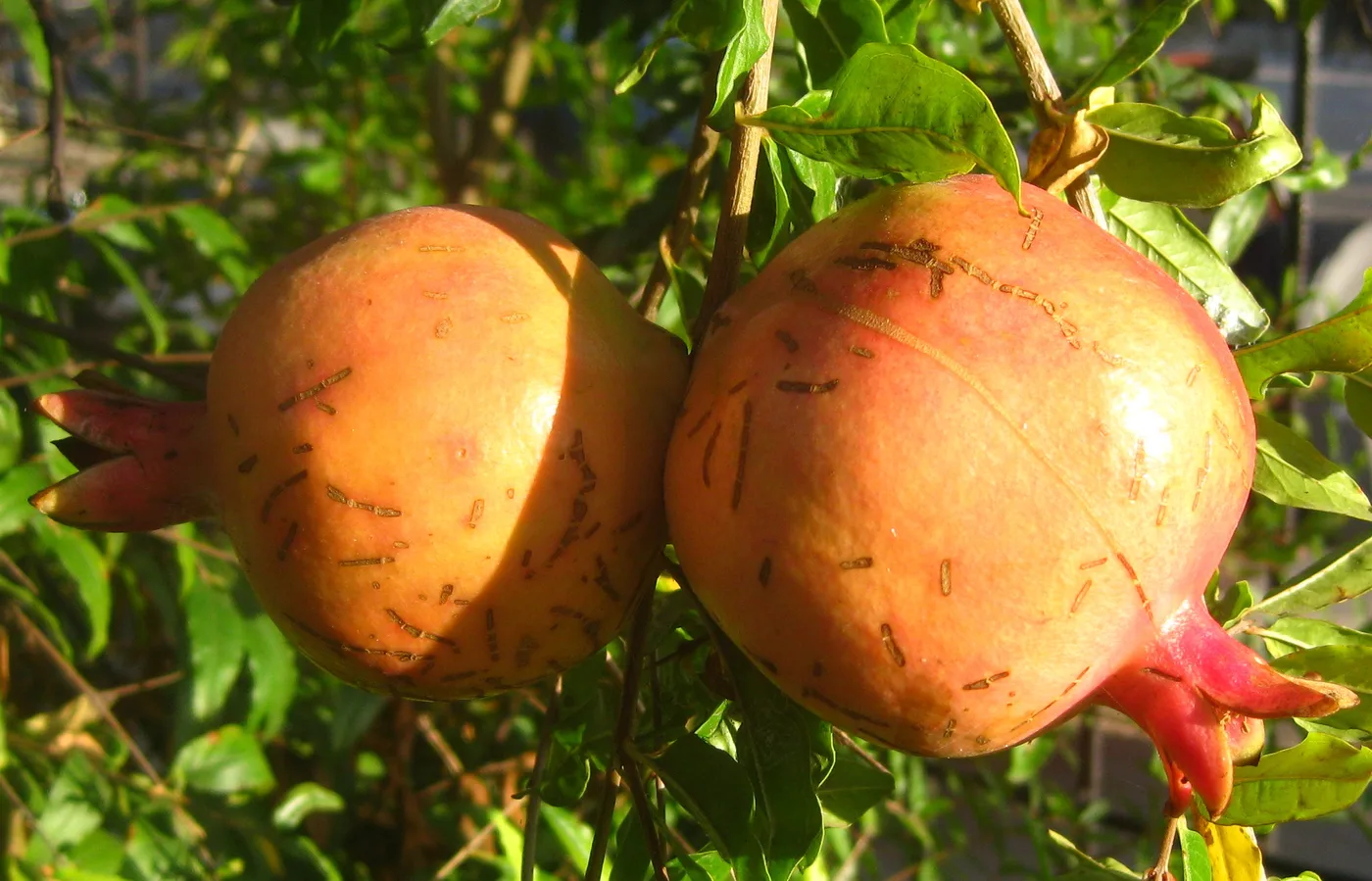
Although the pomegranate has been introduced recently throughout Africa, it is not well-known, so the name will most likely need to be transliterated. As the English name is quite long, the translator is advised to translate from another source or look for ways to shorten it, such as “granata fruit.”
EXO 28:33: “On its skirts you shall make pomegranates of blue and purple and scarlet stuff, around its skirts, with bells of gold between them.” Here the writer is talking about making images of pomegranate fruit from cloth (“blue and purple and scarlet stuff”). One could say something like “… take colored string [or, cotton] and make things like pomegranate fruit … .” Also consider using an illustration. Finally, one could consider using “like the fruit of trees” in the text, and designating the species (pomegranate) in a footnote. LB takes the pomegranates as embroidered, but the impression is given that the bells are also embroidered, which seems odd, as they need to tinkle (verse 35). NCV says “balls like pomegranates,” which is clear. For verses 33–34 CEV provides a helpful model, saying “Along the hem of the robe weave pomegranates of blue, purple, and red wool with a gold bell between each of them.”
1KI 7:18: Instead of “pomegranates,” some Hebrew manuscripts read “pillars” (‘amudim rather than rimmonim). HOTTP favors ‘amudim here but only with a “C” rating. Possible reasons for supposing there was a change of the text from ‘amudim to rimmonim are:
a) The difficulty of the reading “pillars.” It is quite likely that the scribe felt that “pomegranates” made more sense.
b) Similarity to parallel passages. In this case, the scribes probably looked at verses 20 and 42, and possibly at 2CH 3:16, all of which have rimmonim.
If “pomegranates” is chosen (so Septuagint, RSV, and most modern versions), there are still questions. It is impossible to tell from the Hebrew whether these bronze fruits were cast separately (as NAB clearly states), or whether they were hammered or etched into the bronze surface (CEV “designs that looked like pomegranates”).The essential thing to convey is that these objects are models or pictures of the fruit of the pomegranate, which is well described in FFB, pages 168–170.