Discussion
A survey of the English versions indicates the vigorous debate, if not confusion, surrounding the Hebrew word ’almug in 1 Kings and its parallel ’algum in 2 Chronicles. The majority of English versions (RSV, NRSV, NIV, REB, NJB) transliterate directly from the Hebrew in both books, but GNB, CEV, and NCV harmonize 1 Kings and 2 Chronicles by using “juniper” throughout. GECL likewise avoids the issue by translating “precious wood” in both books. The debate hinges on two questions:
1. Is ’almug in 1 Kings the same as ’algum in 2 Chronicles?
2. Where does the ’almug /’algum tree come from?
Note where they are said to come from: 1KI 10:11, ’almug from Ophir; 2CH 2:7, ’algum from Lebanon; 2CH 9:10, ’algum from Ophir.
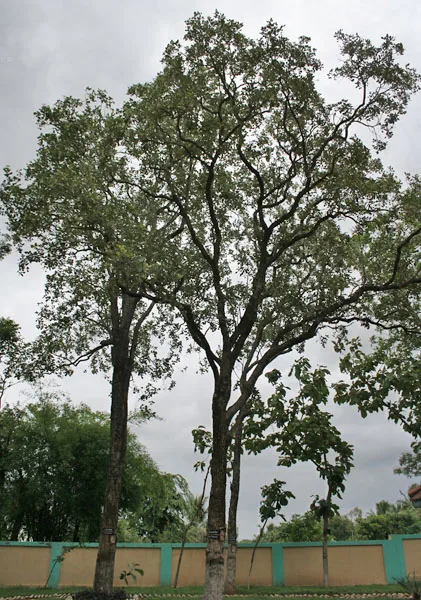
The botanical commentators stand as follows: Zohary, following Tristram, says that the trees are the same, that is, red sandalwood (Pterocarpus santolinus, also called red saunders) from India (via Ophir). Hepper, following Moldenke, Celsius, W. Smith and others, says the trees are different: ’almug is the red sandalwood; ’algum is the Grecian Juniper Juniperus excelsa of Lebanon.
According to FFB, the trees are the same, of unknown origin but maybe the red sandalwood, the white sandalwood, or the Phoenician juniper.
The biblical commentators Keil and Delitzsch consider the trees to be the same, namely sandalwood. According to them, in 2CH 2:8 the writer mistakenly groups ’algum with cedar and cypress as products of Lebanon, whereas ’algum should stand separately with “precious stones,” as it does in 2CH 9:10. Furthermore, G. H. Jones argues it should be ’almug, not ’algum, on the basis of cognates in Ugaritic (’-l-m-g) and Akkadian (elammakku). Furthermore, a dialect of Sanskrit has the word mocha for the sandalwood tree (see also the appendix below). Adding the Arabic definite article al could explain al-mug (and Arabic typically changes o to u in loan words). Greenfield and Mayrhofer (1967, quoted in Hepper) also hold on philological grounds that ’algum and ’almug are the same thing; they identify it with a tree from Lebanon which they do not name. Ugaritic records, incidentally, refer to a tree called ’-l-m-g.
On a quite different track, Hareuveni (page 99) tries to make a case for translating ’almug as “coral,” a mineral product found in the sea, on the ground that ’almog is the modern Hebrew word for coral. It makes a good pair with “precious stones.” Hareuveni quotes the Babylonian Talmud, which describes in detail how these “coral trees” are brought up from the bottom of the Mediterranean Sea.
The translators of GNB, CEV and NCV (following FFB, which follows Koehler and Baumgartner) hold that the phrase “’algum from Lebanon” in 2CH 2:7 is basic and that it must refer to the Phoenician juniper (see Phoenician juniper (coastal juniper)). Then they harmonize 1 Kings with 2 Chronicles.
Looking at the accounts in 1 Kgs 10 and 2 Chr 9 as stories about Hiram’s contribution to King Solomon, one may observe first of all that the accounts are both awkwardly interrupted by the story of the visit of the queen of Sheba.* They are almost word-for-word parallels except for the ’almug /’algum difference. King Hiram brought gold from Ophir, and also, incidentally, ’algum /’almug wood and precious stones. 1 Kings refers to ’almug three times; the parallel account in 2 Chronicles mentions ’algum twice, with the third parallel clearly implied. It is difficult to escape the conclusion that they refer to the same product, and that the variation is caused by the simple inversion of the two Hebrew consonants mem and gimel in one account. Neither account says where the wood came from, but it seems not to be Lebanon. This seems to rule out “juniper” (as in GNB, CEV, and NCV). And it may not be Ophir. Which of the two readings is earlier? It is generally accepted that the Kings account came first and that the Chronicler used the Deuteronomic Kings account (with ’almug) as a reference. Let us assume that ’almug is prior.
Note that 2CH 2:7 (8) expresses King Solomon’s desire that King Hiram send him “cedar, cypress and ’algum.” There is no exact parallel to this in 1 Kings, but in 1KI 5:7; 1KI 5:8; 1KI 5:9 we have King Hiram’s response to Solomon’s request. He says that he will send Solomon cedar and cypress. There is no reference to any other type of wood. But when we get to 2CH 9:10 we find that Hiram sends algum wood and precious stones. We can conclude that ’algum was added to 2CH 2:7 in order to anticipate the statement in 2CH 9:10 (and 1KI 10:11) that Solomon brought ’algum wood for use in the Temple. Unfortunately, the way it was added makes it sound as though the precious wood is from Lebanon. 2CH 8:18 and 2CH 9:10 (interrupted by the queen of Sheba story) clearly separate the gold (from Ophir) from the algum and precious stones (origin unspecified). We conclude that, in adapting the text of 1KI 10:11; 1KI 10:12, the scribe preparing 2CH 9:10; 2CH 9:11 inverted the consonants, yielding ’algum, and the other reference in 2 Chronicles was adapted to harmonize with the first.
Description
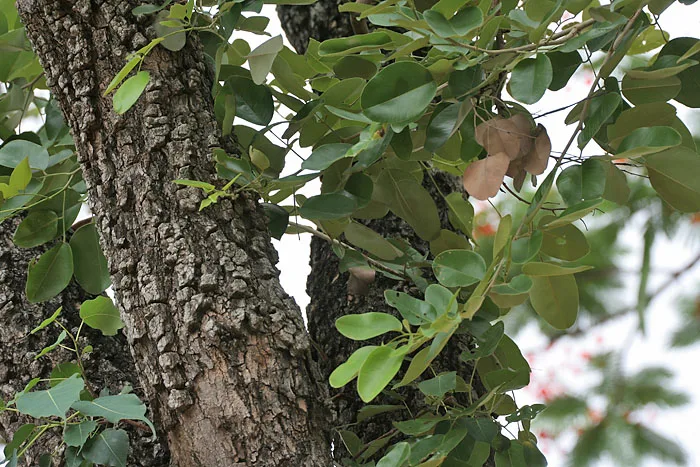
The Red Sandalwood Pterocarpus santolinus is a large tropical tree with hard, reddish wood and yellow flowers. The fruit appears as a pod with two seeds in it.
Translation
Translation options are:
1. Use a relative of the sandalwood present in the local area, or transliterate from a major language.
2. Take 1 Kings as “original” and use a transliteration of mug /mok or almug /almok in both books. 2CH 2:7 could then have a footnote explaining that the Hebrew has ’algum. (A study Bible would explain why this tropical tree came to be in this verse about Lebanon.)
3. Generalize by using “precious wood” in both books as in GECL.
4. Transliterate from the Hebrew in both 1 Kings and 2 Chronicles as in RSV and NIV, live with the tantalizing similarity (for example, aligumu /alimugu), and wait for archeologists to discover samples at the Temple Mount.
Zohary suggests that 2CH 2:7 a be revised to read “Send me also cedar [and] cypress from Lebanon and [also] algum timber.” This matches better with 1 Kings but may be a more radical rearrangement of the grammar than some translators will allow.
Appendix
Zohary and others have argued for ’almug being sandalwood on the grounds that mug is cognate with the Sanskrit mocha, with the definite article al prefixed. This assumes that the Arabs were trafficking in sandalwood, using the name almuka or something like it, and that the Arabic word came into the Hebrew Bible at the time of the writing of 1–2 Kings and 1–2 Chronicles. There is a question, however, whether the definite article was in use in Arabic at the time these books were written. Moscati’s An Introduction to the Comparative Grammar of the Semitic Languages says that most texts of Epigraphic South Arabian and Early Northern Arabic (fifth century B.C. to fourth century A.D.) have no definite article, but instead suffix a nun or mem for the absolute state (as in Babylonian). It has been assumed until recently that the article al appears regularly only in classical Arabic (beginning in the fourth century A.D. onward). However, two important exceptions with al have been found, in the form of inscriptions, and Moscati concedes that they may date to the Early Northern Arabic Period. Further, Herodotus, writing in the fifth century B.C., already uses a phrase for “the goddess” with both of the prefixes h /hn and al in an Aramaic inscription.
1 Kgs
1KI 9:26; 1KI 9:27 gold from Ophir
1KI 10:11; 1KI 10:12 ’almug and precious stones
1KI 10:14; 1KI 10:15 total amount of gold
2 Chr
2CH 8:17; 2CH 8:18 gold from Ophir