Discussion
The English versions of ISA 28:25; ISA 28:27; ISA 28:27 reveal the confusion of the translators who have encountered the Hebrew word qetsach. It has been rendered “fitches” (KJV), “dill” (RSV, GNB, CEV, NLT, NEB, REB), “fennel” (JB, NJB), and “caraway” (NIV). Against all of these renderings, Zohary confidently asserts that the word qetsach refers to the Nigella plant Nigella sativa, also called by the names nutmeg flower, black cumin, black seed, charnushka, and kalonji. (The Hebrew word kammon in these verses refers to the ordinary cumin; see Cumin (cummin)) Hepper agrees, apparently supported by Post, Moldenke, and others. The Aramaic and Arabic equivalent is qatscha. Jews, Arabs, and Europeans use nigella seeds to decorate cakes and bread up to the present. It is also used as a spice in cooking.
Description
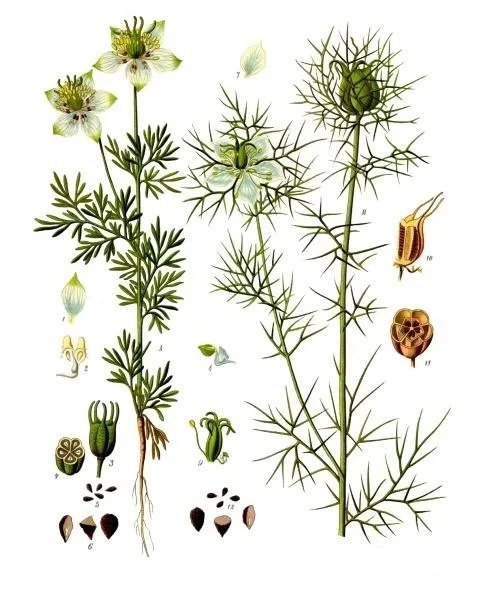
Nigella is planted and harvested annually. It grows to around 30 centimeters (1 foot) in height and has a lacy leaf like dill or carrot and a greenish-blue flower with five petals. The base of the flower becomes a seedpod that contains many round, black, sharp-smelling seeds.
Special significance
Nigella is used by Isaiah as one of several species in a parable he tells to the leaders of Israel. A farmer, he says, does not destroy the results of one season’s work while preparing for that of the next season. This is spoken to know-it-all scoffers who claim that God’s ways are completely fixed. Against that Isaiah says that God’s ways are according to the conditions of his creatures, as a farmer plants and harvests according to the needs of the various crops.
Translation
The abundance of names for nigella is an indication of its popularity around the world. Fortunately the Latin name nigella is now replacing the confusing name “black cumin.” This is good because cumin is a totally different plant. Likewise, “nutmeg flower” and “black caraway” are losing favor. So translators can avoid the confusion brought on by the English by transliterating from Latin (nigella), French and Dutch (nigelle), Spanish (agenuz, neguilla, arañuel), German (Nigella, Schwartzkümmel [literally “black seed”]), Hebrew (qetsach), Persian (kalanji), or Arabic (habbet as suda, kamun aswad, shuniz). In Amharic nigella is tikur azmud, in Mandarin hei zhong cao, and in Indonesian jinten hitam.